What Changes on 1 October 2026, and How Exposed You Are
Practice One: Send Fewer, Fuller Messages
Practice Two: Let Automation Answer the Repeats
Practice Three: Collect Details in a Flow, Not a Conversation
Practices Four and Five: Use the Free Windows, and Stop Paying Twice
Practices Six and Seven: Coexistence, and Routing Low-Value Questions Away
What Does Not Change, and What Nobody Can Tell You Yet
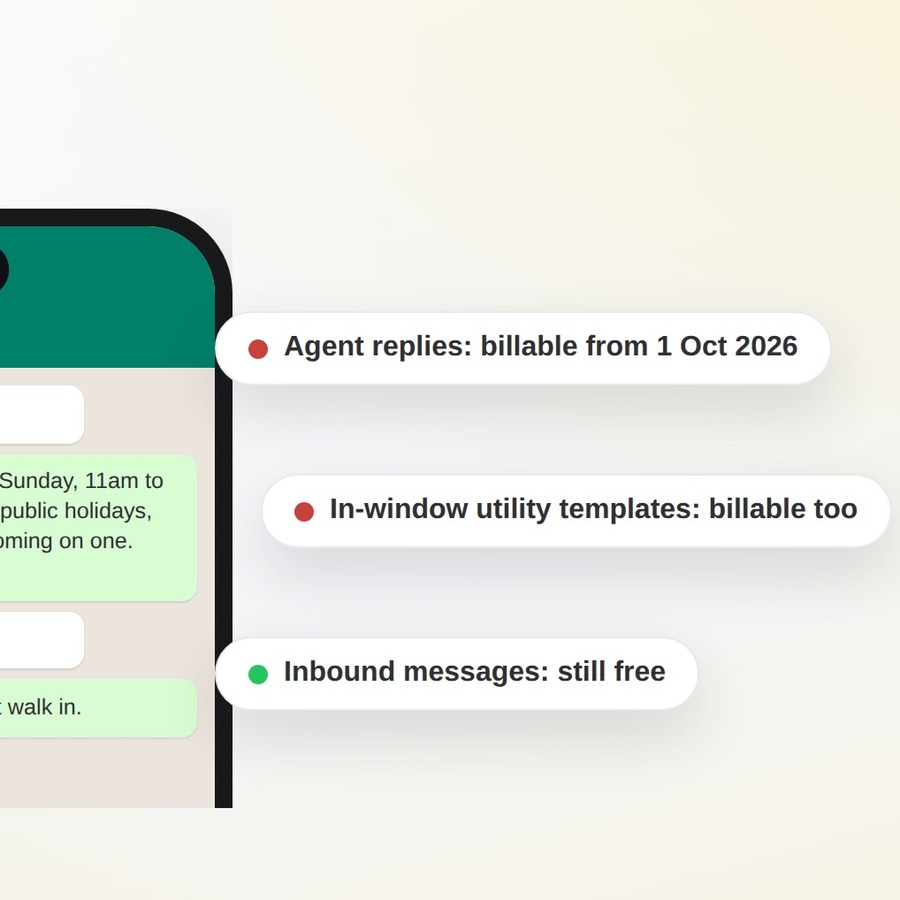
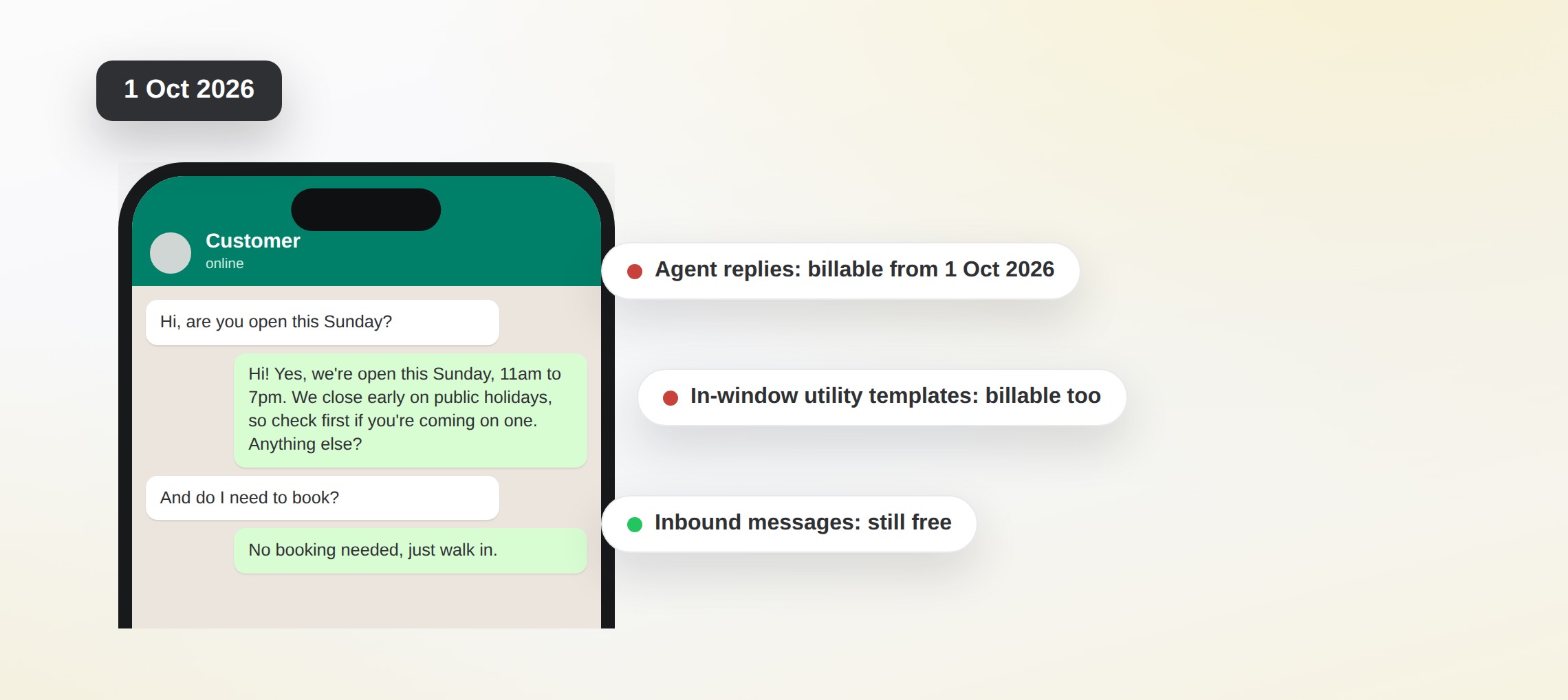
Meta bills per delivered message. From 1 October two categories join the ones you already pay for:
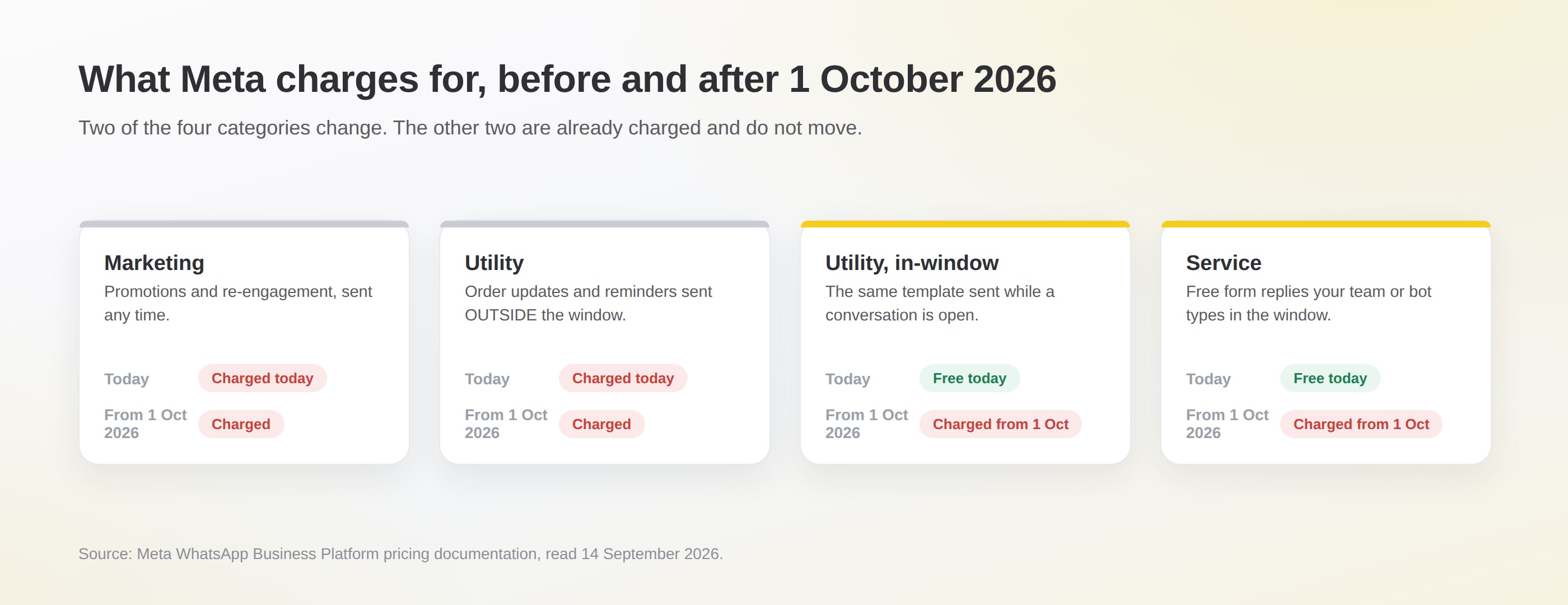
Meta's own worked example: one interaction, one hour, same messages throughout.
| When | What Meta charges for that interaction |
|---|---|
| August 2026 | 3 charges |
| From 1 October 2026 | 5 charges, the two new ones being a rep's reply and an order confirmation sent inside the window |
Before changing anything, pull three numbers. They tell you whether this is a rounding error or a real line in next year's budget.
| Number | Where it comes from | What it tells you |
|---|---|---|
| Service messages delivered per month, per number | Pricing Analytics API, SERVICE category | The size of the new charge |
| Messages sent per resolved conversation | Inbox reporting, or hand-count 50 threads | How much volume is reply habit rather than customer demand |
| Utility templates sent while a window was open | Template logs, filtered to in-window sends | The half most internal estimates leave out |
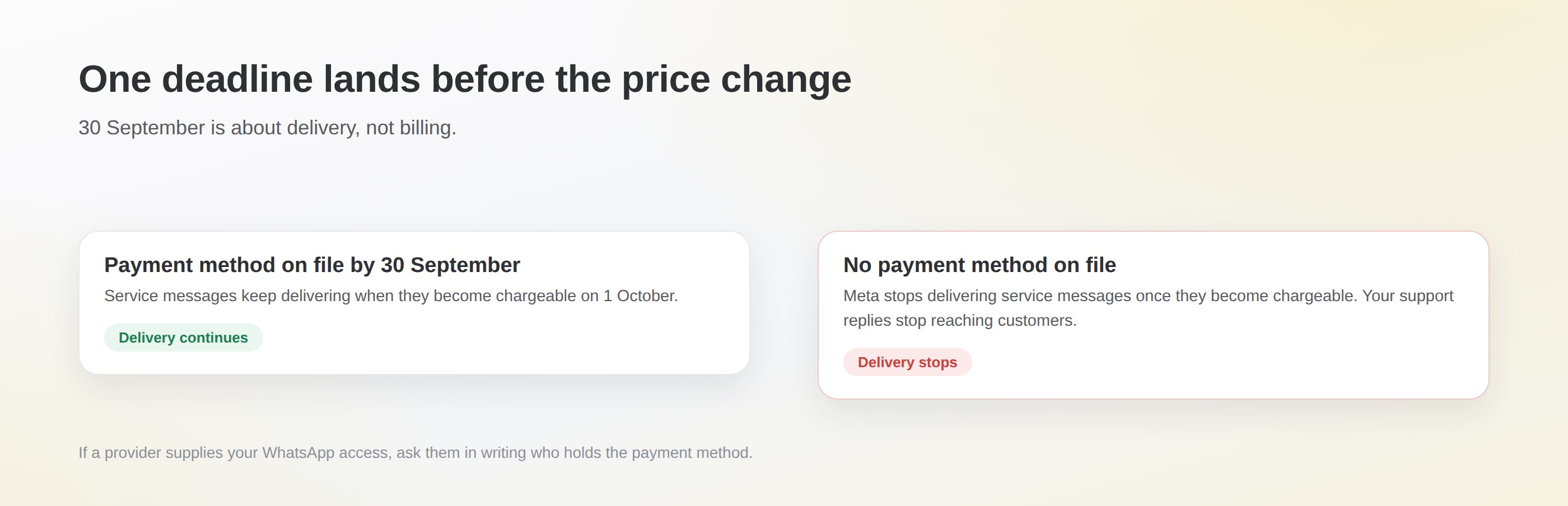
One deadline lands before the price change, and it is about delivery rather than cost. Meta has stated that a Solution Provider or directly integrated business without a payment method on file by 30 September 2026 will have service messages stopped once they become chargeable. If someone else provisions your access, ask them in writing who holds the payment method.
If you send a few hundred replies a month, this is a small number and you should spend your attention elsewhere. We would rather say that than sell you a project.
A greeting, the answer, a caveat, an offer to help further. Four delivered messages, four charges, for content that fits comfortably in one. This is the cheapest change on the page and usually the largest saving.
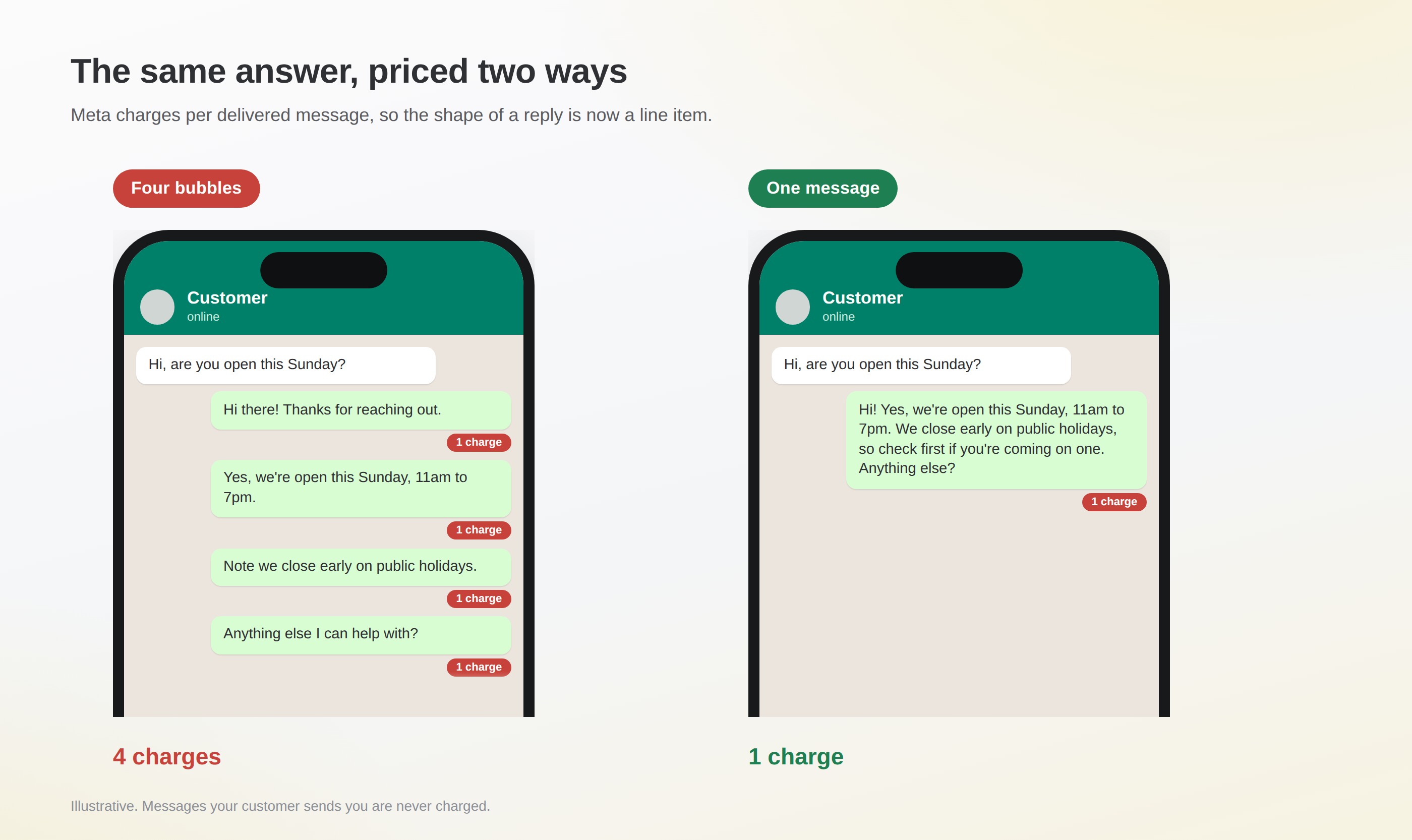
One caveat, and we mean it: a thread that takes two extra rounds because the customer couldn't find the answer costs more than the bubble you saved.
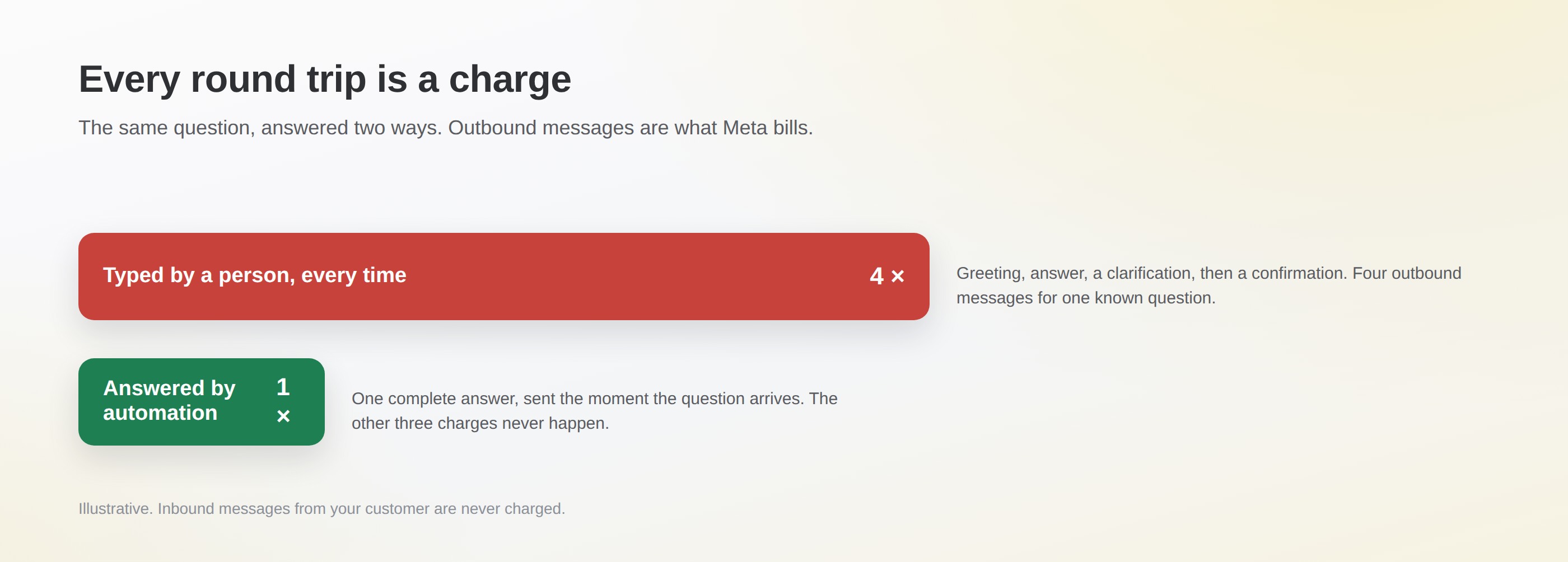
Opening hours, order status, delivery windows, branch addresses. If a question has one correct answer and a meaningful share of your inbox, a human typing it is paying a per message fee to do work a rule could do.
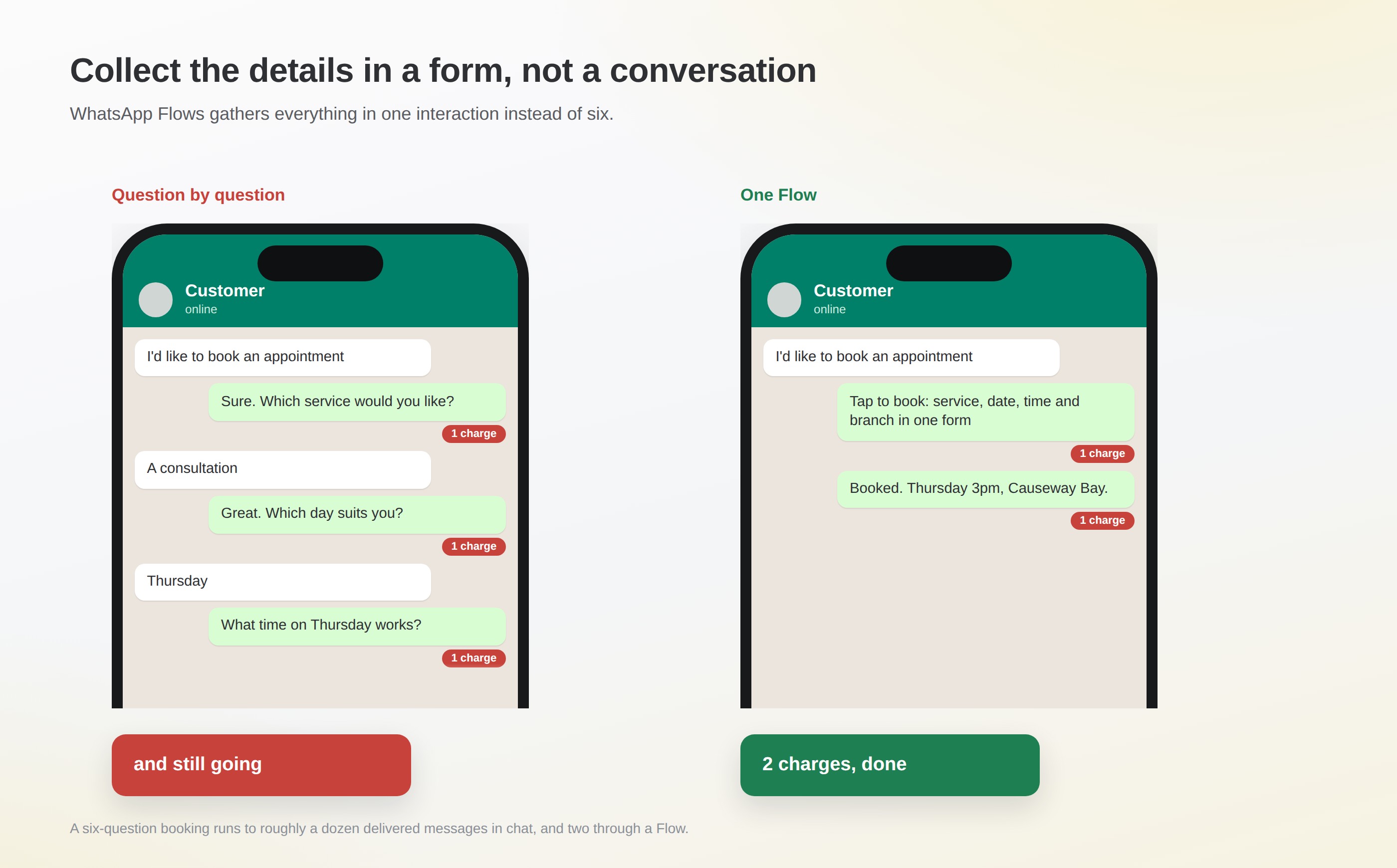
Which service, which date, which time, which branch, what name, what number. Asked one at a time, that is roughly a dozen delivered messages before anything is booked. WhatsApp Flows gathers the same fields in a single form, so the exchange becomes one message to open it and one to confirm.
| Approach | Messages you deliver | Where the cost sits |
|---|---|---|
| Question by question in chat | Roughly 10 to 14 | Every clarification is a separate charge |
| One Flow, then confirm | Roughly 2 | One message opens the form, one confirms |
| Automation plus human handoff | Roughly 3 to 5 | Automation takes the known part, a person the exception |
Anything you currently ask for in sequence is a candidate: bookings, returns, claim details, delivery preferences, qualification questions on an inbound lead.
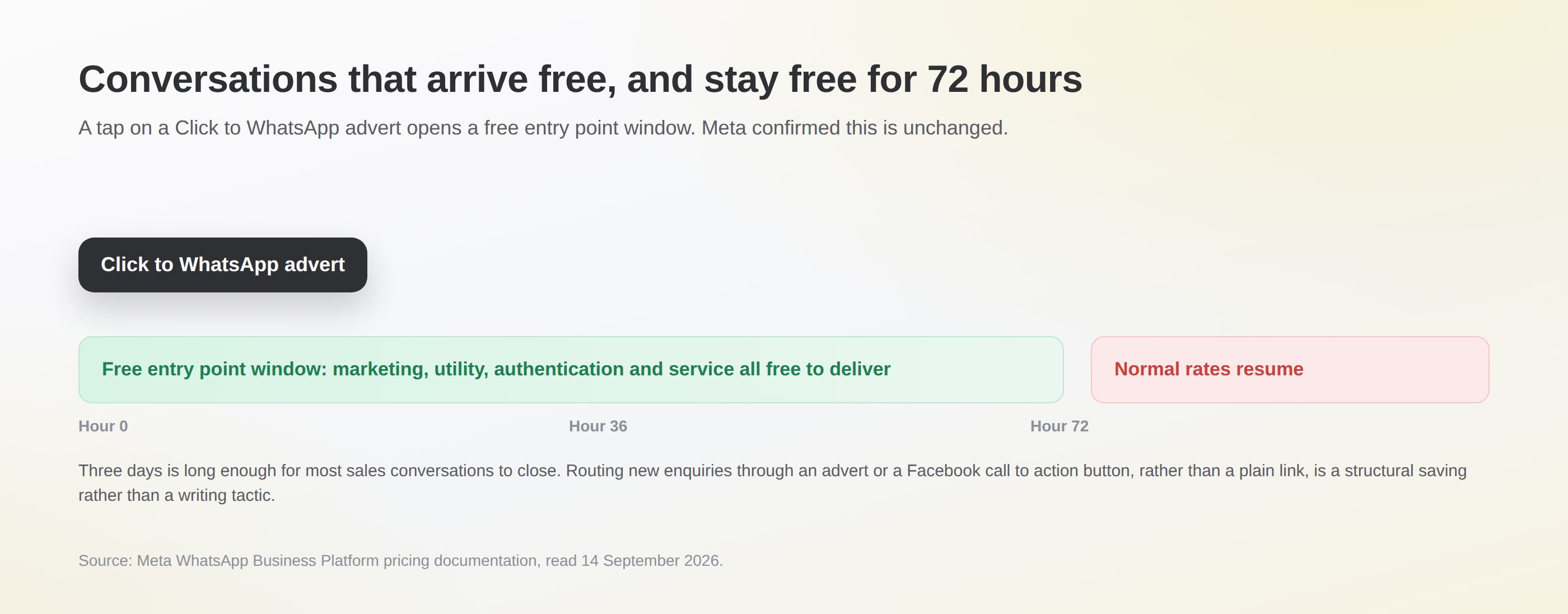
Practice four, bring conversations in through a free entry point. A tap on a Click to WhatsApp advert or a Facebook call to action button opens a 72 hour free entry point window. Marketing, utility, authentication and service messages sent inside it are not charged for delivery, and Meta confirmed this is unchanged. Three days is long enough for most sales conversations to close, and it is a routing decision rather than a writing one.
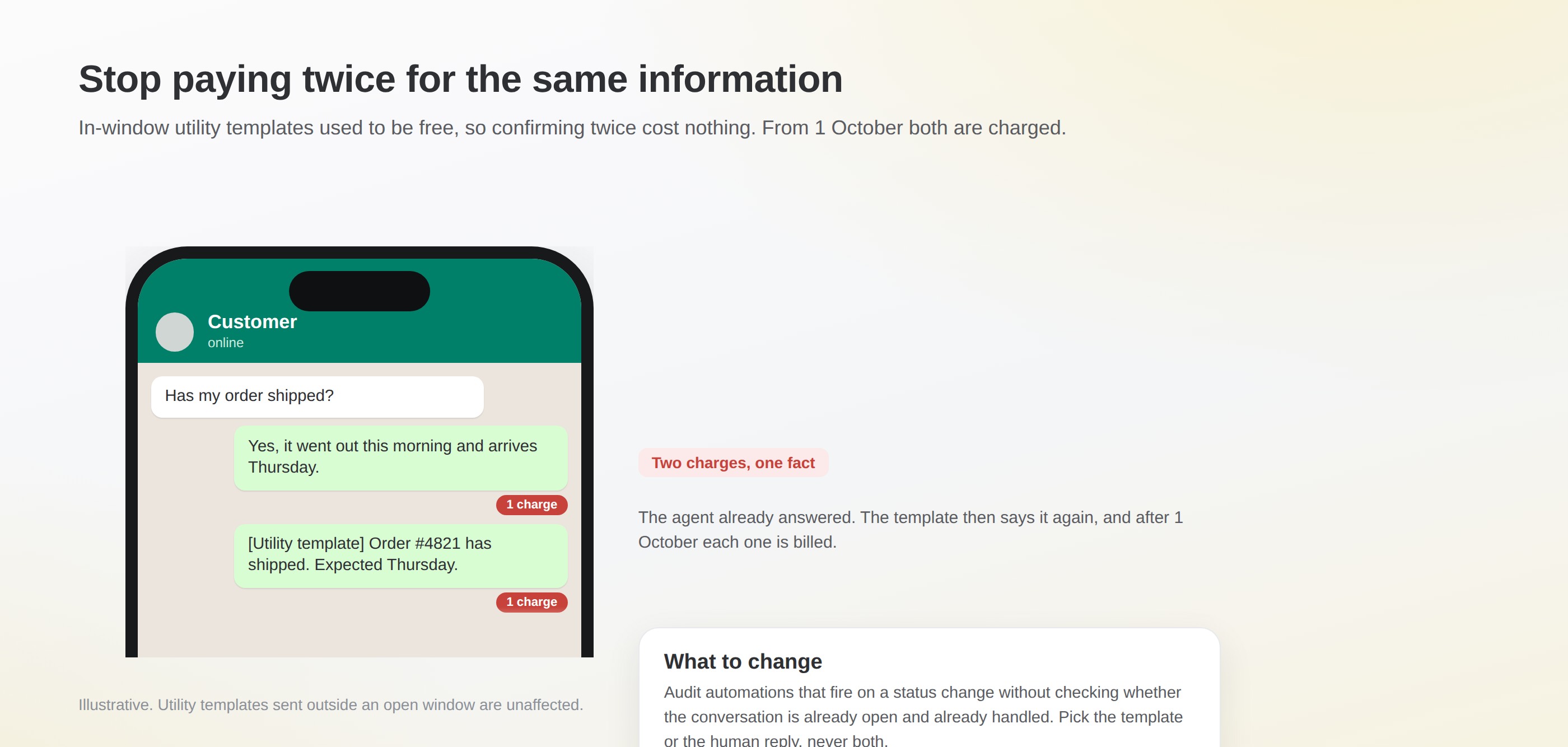
Practice five, stop paying twice for the same information. In-window utility templates used to be free, which made it painless to confirm something in chat and then fire the formal template as well. Both now cost. Audit for:
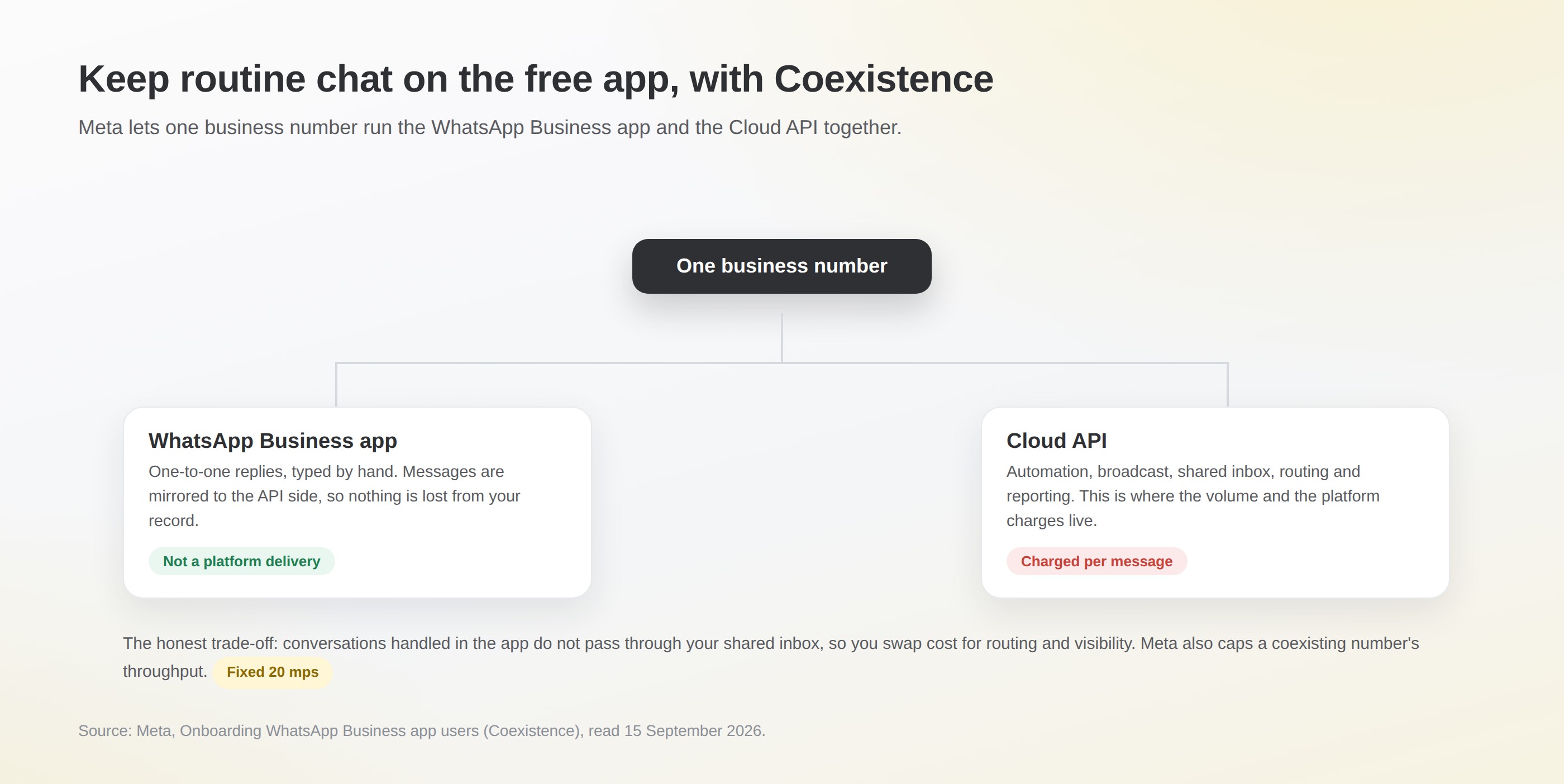
Practice six, keep routine one-to-one chat on the WhatsApp Business app. Meta supports running the Business app and the Cloud API on the same business number, which its documentation calls Coexistence. Messages are mirrored between the two, so nothing disappears from your record, and replies typed in the app are not platform deliveries.
The trade-off is real and worth stating: conversations handled in the app do not pass through your shared inbox, so you swap cost for routing, reporting and visibility. Meta also fixes a coexisting number's throughput at 20 messages per second, which matters if you broadcast.
Practice seven, send low-value questions to a cheaper channel. Not every enquiry needs to arrive on WhatsApp at all.
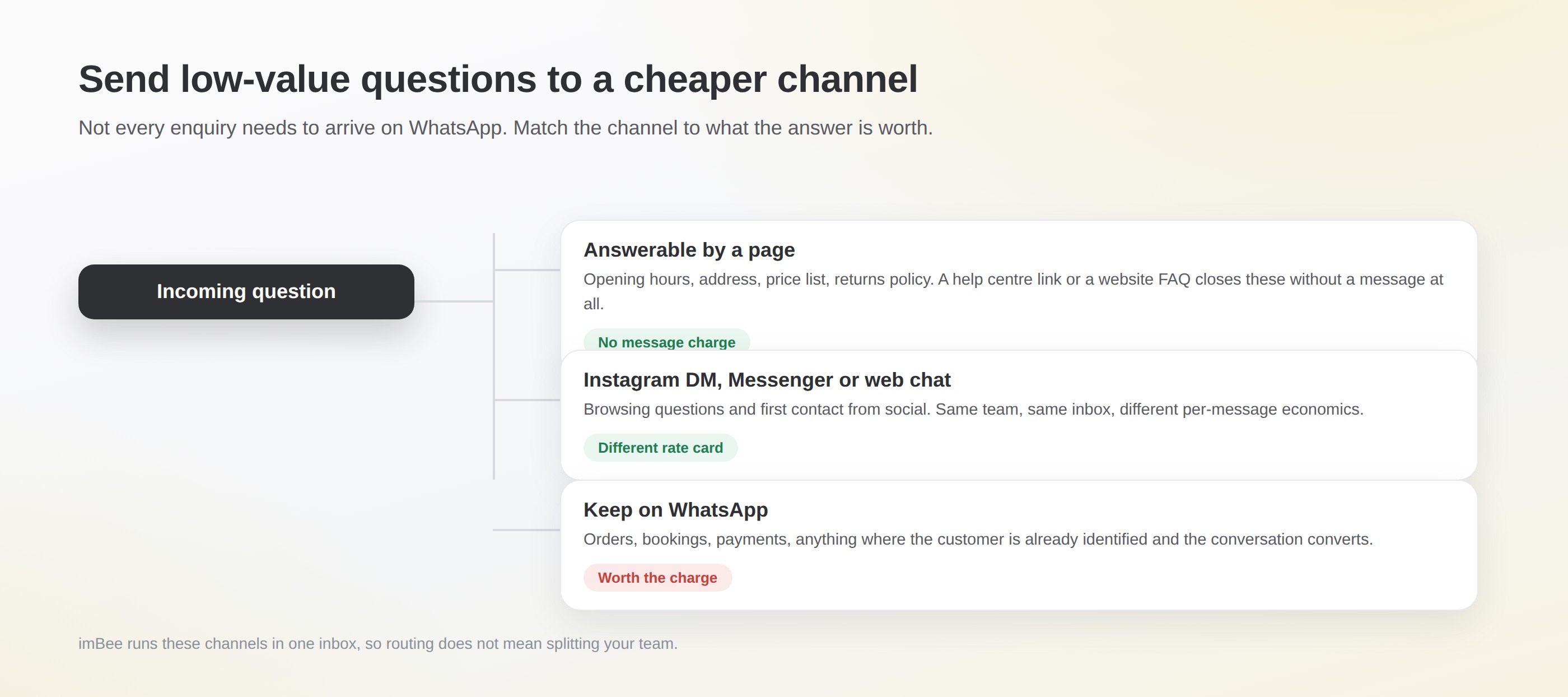
This only works if the channels sit in one place. Routing should not mean splitting your team across four inboxes, which is the usual reason it gets abandoned.
Several things people assume are changing are not:
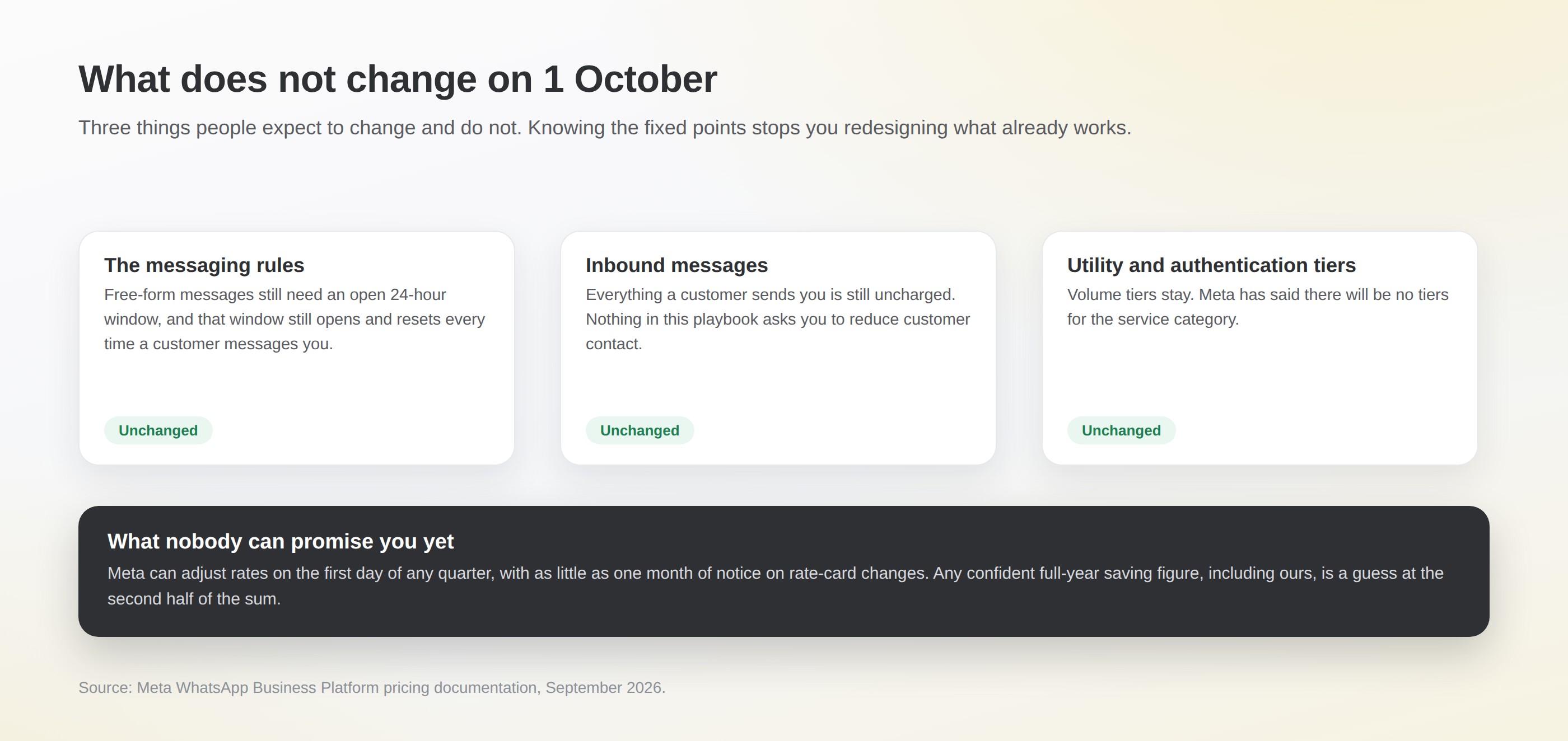
And here's what can't be stated honestly in advance. Meta may update pricing on the first day of any quarter with as little as one month of notice on a rate card change, so a figure published today carries no promise about January. Anyone quoting a confident annual saving, us included, is guessing at the second half of the arithmetic.
What exactly changes on WhatsApp pricing on 1 October 2026?
Two message types that carry no charge today become billable per message. Service messages, meaning the free form replies your team sends inside the 24 hour customer service window, and utility templates sent in response to a customer inside that same window. Meta charges the same rate for service messages as it does for utility and authentication messages in each market.
How much more will this cost my business?
It depends almost entirely on the ratio of conversational replies to outbound campaigns in your traffic, so the honest answer is to measure rather than estimate. Pull your delivered service message volume per phone number for a representative month from Meta's Pricing Analytics API, then count how many messages a typical resolved conversation takes. A support-heavy operation sees a much larger percentage change than a broadcast-heavy one, even at identical total volume.
Does this affect appointment reminders and order updates?
Only when they are sent inside an open 24 hour customer service window, which is the half of this change most summaries miss. A utility template sent to a customer who has not messaged you recently is charged exactly as it is today. The same template sent while a conversation is open used to be free and becomes chargeable on 1 October, so operations that reply and then confirm by template are paying twice for one exchange.
Can we keep using the free WhatsApp Business app to save money?
Partly, and Meta supports it. Its documentation covers onboarding WhatsApp Business app users, which it refers to as Coexistence: one business number can run the Business app and the Cloud API together, with messages mirrored between them. Replies typed one-to-one in the app are not platform deliveries. The trade-offs are that those conversations bypass your shared inbox, automation and reporting, and that Meta fixes a coexisting number's throughput at 20 messages per second.
Should we move some conversations off WhatsApp entirely?
For low-value enquiries, often yes. Opening hours, addresses and returns policies are answered by a help centre page with no message charge at all. Browsing questions and first contact from social can sit on Instagram DM, Messenger or web chat, which carry different per-message economics. Keep WhatsApp for orders, bookings, payments and anything where the customer is identified and the conversation converts. This only works if all the channels land in one inbox, otherwise routing just splits your team.
What is the 30 September deadline about?
It is a delivery deadline rather than a pricing one. Meta has stated that any Solution Provider or directly integrated business without a payment method on file by 30 September 2026 will have service messages stopped once those messages become chargeable on 1 October. If a provider supplies your WhatsApp access, ask them in writing who holds the payment method against your WhatsApp Business Account, and get the answer before the end of September.
Are Click to WhatsApp adverts still free after the change?
The 72 hour free entry point window is unchanged for message delivery. When a conversation starts from a Click to WhatsApp advert or a Facebook call to action button, marketing, utility, authentication and service messages sent inside that 72 hour window are not charged for delivery. Meta confirmed this explicitly alongside the October changes, which makes routing new enquiries through those entry points a structural saving rather than a writing tactic.
Are there volume discounts on the new service message charge?
No. Meta has confirmed it will not offer volume tiers for service messages, while it continues to offer them for utility and authentication messages. High volume senders who already benefit from tiered utility rates should not assume the same ladder applies to the service line, and should model the service charge at a flat rate per delivered message when budgeting.

Kelly S.
Content Team Lead, imBee
Kelly S. owns content strategy, product positioning, and customer education at imBee. Previously, Kelly led B2B SaaS content programs and supported go-to-market initiatives for customer engagement products. On the imBee blog, Kelly covers conversational commerce, omnichannel messaging, WhatsApp Business, customer experience, and strategies for scaling business communications.
Questions about anything in this article? Talk to our team.