WhatsApp for Healthcare in Hong Kong: Why Patient Messaging Is Moving Off SMS and Phone Lines
Is WhatsApp Compliant for Patient Data Under Hong Kong’s PDPO?
WhatsApp Business App vs WhatsApp Business Platform (API): Which Does Your Practice Need?
9 Patient-Messaging Use Cases That Cut No-Shows and Free Up Front-Desk Staff
How Message Templates, the 24-Hour Window, and Conversation Pricing Actually Work
Security and Data Governance: ISO 27001, Encryption, and Where Patient Data Lives
Getting Started: An 8-Step Rollout Checklist, FAQs, and Next Steps
In Hong Kong, WhatsApp is effectively the default messaging layer for daily life. For a clinic, dental practice, diagnostic centre, or private hospital, that creates a simple opportunity: reach patients where they already read, on a channel with far higher open and response rates than SMS or email, with nothing new to download.
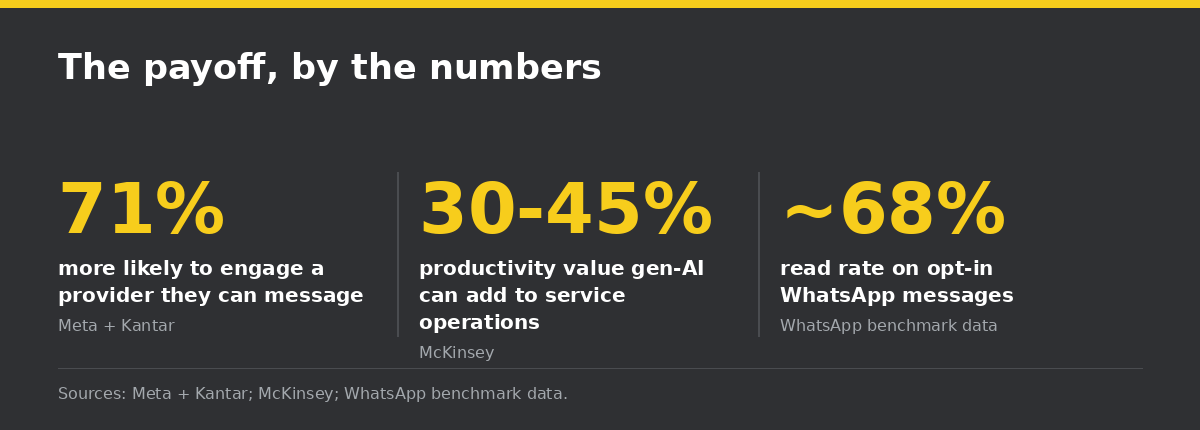
The payoff, by the numbers
Before the how-to, here is why this is worth your team’s time. These are the benchmarks business-messaging programmes are measured against:
The catch is that healthcare is one of the most sensitive data environments there is. Appointment details, test results, and even the fact that someone is a patient at a particular specialist are protected personal data under Hong Kong’s Personal Data (Privacy) Ordinance (Cap. 486). Using WhatsApp well means satisfying the Office of the Privacy Commissioner for Personal Data (PCPD), the Medical Council’s expectations on confidentiality, and your own information-security obligations.
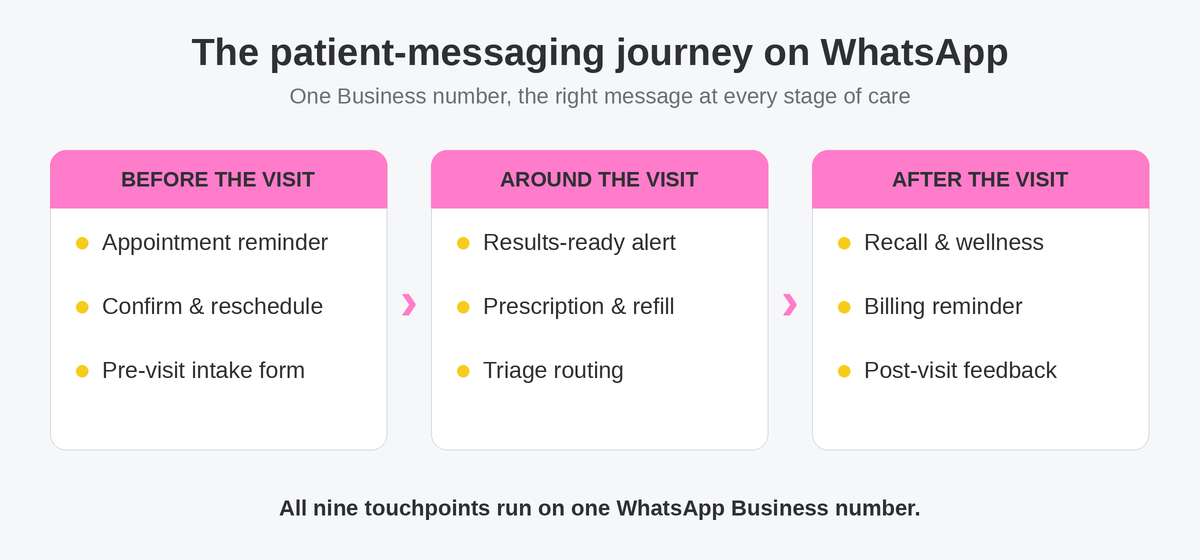
This guide is written for the operations and customer-experience leaders who own that decision. Nine things it covers:
The PDPO is built around six Data Protection Principles (DPPs). A clinic does not need to memorise the statute, but the patient-messaging programme has to respect each principle. The table below maps the six DPPs to concrete WhatsApp practices.
| Data Protection Principle | What it means for WhatsApp patient messaging |
|---|---|
| DPP1 – Collection | Collect a patient’s WhatsApp number for a stated purpose (e.g. appointment reminders) and tell them so at the point of collection. |
| DPP2 – Accuracy & retention | Keep numbers current and stop messaging patients who have left the practice; do not retain chat data longer than needed. |
| DPP3 – Use | Use the number only for the purpose consented to. Sending a marketing wellness offer to someone who only consented to reminders breaches DPP3. |
| DPP4 – Security | Protect the data with encryption, access controls, and a vetted platform — the core of the security section below. |
| DPP5 – Transparency | Maintain a privacy policy that explains your messaging practices and how patients can opt out. |
| DPP6 – Access & correction | Let patients see and correct the personal data you hold, including messaging records. |
Two points deserve special attention. First, direct marketing — promotional wellness campaigns and package offers — is governed by Part VIA of the Ordinance, which requires explicit consent and a no-cost opt-out. Reminders the patient asked for are generally not direct marketing; a discounted health-screening promotion is. Keeping those two streams separate, with separate consent, is the most common compliance gap. The Ordinance text sits on the Government’s e-Legislation portal, with guidance at pcpd.org.hk.
Second, patient confidentiality is a professional obligation too. The Medical Council of Hong Kong sets clear expectations on safeguarding patient information, so message content should avoid exposing clinical detail a third party glancing at a phone could read — “Your results are ready, please call to discuss” rather than a diagnosis in the message body.
The free WhatsApp Business App is a phone app for a single device and a small team. The WhatsApp Business Platform — also widely called the WhatsApp Business API, WABA, or the WhatsApp Cloud API — is the enterprise route: no chat app, but a connection that lets a platform like imBee handle many agents, automation, templates, and audit logging on one official business number. Access to the Platform is provisioned through a Meta Business Solution Provider (BSP).
| 維度 | WhatsApp 應用程式 | WhatsApp 平台 (API) |
|---|---|---|
| 最適合 | A solo practitioner or single front desk | Clinic groups, hospitals, diagnostic chains |
| Agents per number | Effectively one device at a time | Many agents on one shared number |
| Automation | Basic quick replies and away messages | Chatbots, routing, WhatsApp Flows, integrations |
| Bulk reminders | Manual, capped, ban-prone | Approved message templates at scale |
| Audit trail & roles | 無 | Full logs, role-based access control |
| Compliance fit for healthcare | Weak | Strong, when run on a governed platform |
For anything beyond a single clinician answering their own phone, the Platform is the only route that supports the access controls, audit logs, and template governance the PDPO’s security principle expects. The trade-off is that it is not free and not a consumer app — it is software a provider connects to your systems. For how regulated teams adopt it, see imBee’s guide to WhatsApp for financial services in APAC, which covers the same security and record-keeping concerns. Meta’s technical overview lives in the WhatsApp Business Platform documentation.
Grouped by the patient journey, here is where WhatsApp earns its place:
Before the visit. Appointment reminders sent a day or two ahead are the highest-leverage use case — reminder systems are well established in health-services research as a way to reduce missed appointments, and WhatsApp’s read rates make them more effective than SMS. Confirmation and rescheduling lets a patient move a slot with one tap instead of a call. Pre-visit intake — history, insurance, consent — can be completed in-chat using WhatsApp Flows, so patients arrive ready and queues shrink.
Around the visit. Results-ready notifications tell a patient their report is available without revealing clinical detail. Prescription and refill alerts prompt repeat patients at the right interval. Triage routing uses a chatbot to direct an enquiry to the right department first.
After the visit. Recall and wellness reminders bring patients back for check-ups, vaccinations, or screening. Billing reminders reduce the chase for outstanding balances. Post-visit feedback captures a quick satisfaction rating for your CSAT tracking.
The table below shows the message type each use case relies on — a distinction that matters for cost and compliance, explained in the next section.
| 用例 | Message type | Outcome it drives |
|---|---|---|
| Appointment reminder | Utility template | Lower no-show rate |
| Confirm / reschedule | Utility template + session reply | Fewer inbound calls |
| Pre-visit intake form | WhatsApp Flow | Shorter check-in queues |
| Results-ready alert | Utility template | Faster, confidential follow-up |
| Prescription / refill | Utility template | Better adherence |
| Recall & wellness | Marketing template (consent required) | Repeat visits |
| Billing reminder | Utility template | Faster payment |
| Triage routing | Session chat + chatbot | Right team, first time |
| Post-visit feedback | Utility template + session reply | Higher CSAT |
The 24-hour conversation window. When a patient messages you, a 24-hour window opens during which agents can reply freely with any content. Once 24 hours pass with no new patient message, you can no longer send free-form text; to re-open contact you must send a pre-approved message template. This rule makes reminder design a deliberate exercise rather than an afterthought.
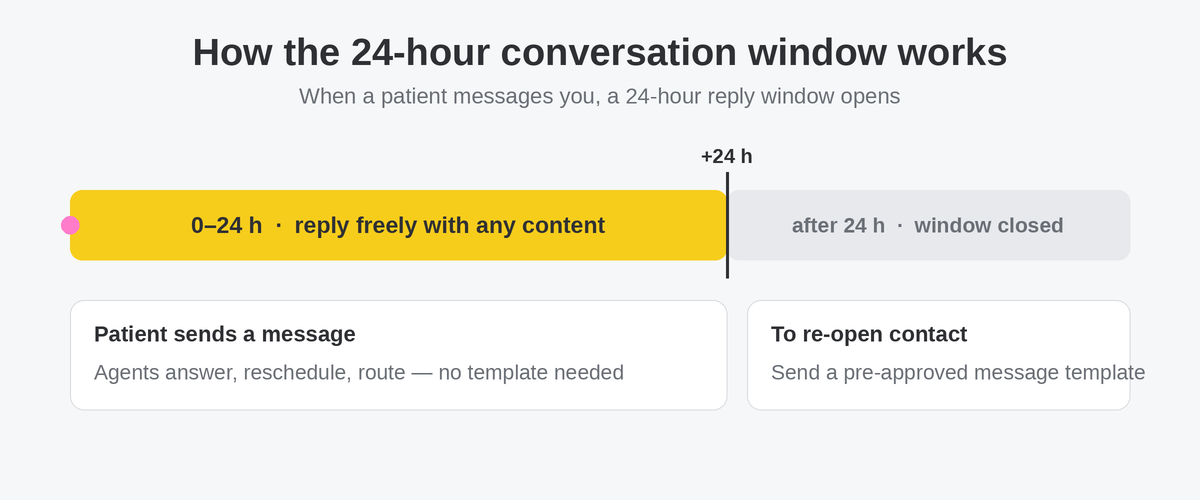
Message templates (HSM). A template is a message format that Meta reviews and approves in advance. Templates fall into categories, and the category determines when it is allowed and how it is priced. The table below shows the categories most relevant to a clinic.
| Template category | Healthcare example | Notes |
|---|---|---|
| 實用性 | Appointment reminder, results-ready alert, billing notice | Tied to a transaction or request the patient initiated; lower cost. |
| 市場營銷 | Wellness package offer, screening promotion | Requires explicit consent under PDPO Part VIA; opt-out required. |
| 驗證 | One-time passcode for a patient portal login | For verification only. |
| 服務 | Free-form reply inside the 24-hour window | Not a template; the agent answering a live conversation. |
Conversation-based pricing. Meta bills WhatsApp per conversation rather than per message, with rates varying by category and country. The takeaway for a clinic: keeping clinical reminders in the lower-cost Utility category, and reserving Marketing templates for consented campaigns, is both cheaper and more compliant. Meta documents the model in its conversation-based pricing reference, and the in-chat form mechanics in the WhatsApp Flows documentation.
A platform handles all of this in the background: it submits templates for approval, tracks which window each conversation is in, and stops an agent from sending free-form text outside it — the difference between a managed programme and a compliance incident waiting to happen.
Encryption in transit. WhatsApp messages are protected by end-to-end encryption between the patient and the business endpoint, and a reputable platform also encrypts data at rest. Meta documents the channel’s protections at whatsapp.com/security.
A certified platform. Encryption on the wire is necessary but not sufficient — the platform that stores conversations, runs your chatbot, and holds agent access must be secured too. ISO/IEC 27001 is the international standard for information security management, and the baseline a healthcare buyer should require of any vendor. imBee operates to this standard (see imBee’s ISO 27001 commitment); the standard itself is published by the International Organization for Standardization.
Access control and audit logs. Under the PDPO’s security principle, you should be able to answer “who saw this patient’s data, and when?” Role-based access — so a receptionist sees scheduling but not clinical notes — plus a complete audit trail of every message and agent action make that possible. The free WhatsApp Business App offers neither; the Platform, run on a governed inbox, offers both.
Vendor and BSP diligence. Because the WhatsApp Business Platform is accessed through a BSP, your data-protection posture is only as strong as that provider’s. Ask where data is hosted, how long conversations are retained, and what certifications the provider holds. Healthcare and financial services face near-identical questions; imBee’s overview of how financial-services teams use WhatsApp walks through the same checklist a clinic should apply.
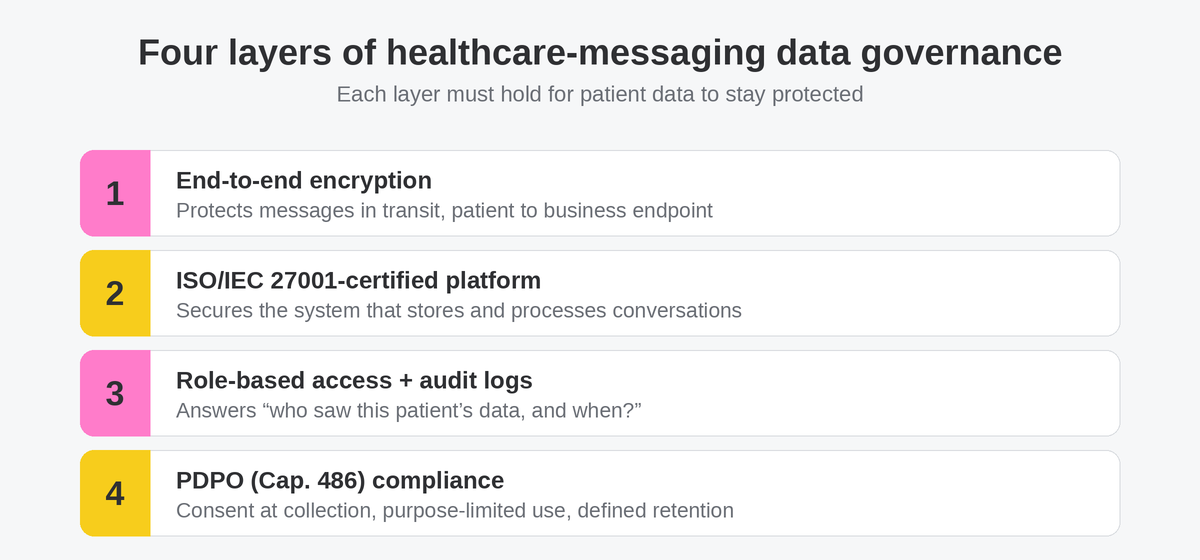
Compliance is not a property of the channel — it is a property of the controls you wrap around it. These seven map directly to what the PDPO (Hong Kong) and PDPA (Singapore) expect of a clinic handling patient data.
| # | Control | What PDPO / PDPA expects | How a clinic implements it |
|---|---|---|---|
| 1 | Lawful basis & consent | Stated purpose at collection; explicit opt-in for marketing | Capture consent at intake or via click-to-WhatsApp opt-in; log the timestamp and source |
| 2 | 資料存放地 | Know where data is stored and transferred | Confirm your platform’s hosting region and cross-border transfer terms |
| 3 | Access control & least privilege | DPP4 / Protection Obligation | Named accounts, role-based permissions, no shared logins |
| 4 | Encryption | Reasonable security arrangements | Encryption in transit and at rest across the platform |
| 5 | Retention & deletion | Keep no longer than necessary | Automated retention clocks; honour deletion requests |
| 6 | Audit logging | Demonstrate accountability | Immutable logs of who accessed which thread, when |
| 7 | Breach response | Contain and notify within legal deadlines | An incident runbook with per-market notification timelines |
Controls 3, 4 and 6 are where an internationally recognised security standard earns its keep. ISO/IEC 27001 is the leading standard for information security management, and a certified platform is independent evidence that access control, encryption and logging are managed systematically rather than improvised. It does not, on its own, prove legal compliance with the PDPO or PDPA — but it is usually the first document a hospital procurement team or risk committee asks for. imBee maintains ISO/IEC 27001 certification, which is why regulated APAC buyers can shortlist it without a six-month security review. You can read the standard itself at ISO.org, and the PCPD’s guidance notes set out its expectations for data security in practice.
Run on a governed, ISO 27001-certified platform, those eight steps give a Hong Kong clinic patient messaging that is faster for staff, easier for patients, and defensible under the PDPO.
Is WhatsApp suitable for healthcare patient messaging in Hong Kong?
Yes. Used on the WhatsApp Business Platform through a vetted, ISO 27001-certified provider, WhatsApp supports compliant patient messaging in Hong Kong. The key requirements are consent recorded at collection, separation of clinical and marketing messages, message content that avoids exposing clinical detail, and proper access controls and audit logging on the platform that stores conversations.
What is the difference between the WhatsApp Business API, WABA, and the WhatsApp Cloud API?
They refer to the same thing. “WhatsApp Business Platform” is Meta’s current name for the enterprise product; “WhatsApp Business API” and “WABA” are the older, widely used terms; and “WhatsApp Cloud API” is Meta’s cloud-hosted way of connecting to it. All describe the route that supports many agents, templates, and automation, as opposed to the free single-device app.
Does using WhatsApp breach the PDPO or patient confidentiality?
Not in itself. The Personal Data (Privacy) Ordinance regulates how you collect, use, and secure the data, not which app you use. Breaches come from poor practice — messaging without consent, mixing marketing into clinical reminders, or exposing diagnoses in message bodies — rather than from the channel. Sound consent, content discipline, and a secure platform keep you compliant.
How does WhatsApp reduce appointment no-shows?
Reminders sent a day or two before an appointment let patients confirm, reschedule, or cancel with one tap. Because WhatsApp messages are read far more reliably than SMS or email, more patients see the reminder and act on it. The result is fewer empty slots and less manual phone-calling for front-desk staff, freeing them for in-clinic work.
Do we need patient consent to send WhatsApp reminders?
You need to collect the number for a stated purpose and tell the patient how it will be used, per Data Protection Principle 1. Service reminders the patient has asked for are generally not direct marketing. Promotional campaigns — wellness packages, screening offers — are direct marketing under Part VIA and require explicit, separate consent with a no-cost opt-out.
Can patients reply and have a real conversation, or is it one-way?
It is two-way. When a patient replies, a 24-hour window opens in which your team can answer freely — rescheduling, answering billing questions, routing to the right department. Outside that window you re-open contact with an approved template. A platform manages the window automatically so agents never send non-compliant messages by accident.
What does WhatsApp for healthcare cost?
There are two layers: Meta’s conversation-based fees, which vary by message category and country, and the platform subscription that provides the inbox, automation, and security. Keeping clinical reminders in the lower-cost Utility category and reserving Marketing templates for consented campaigns controls the Meta layer; the platform layer depends on team size and feature needs.
How long does it take a clinic to go live?
A typical Hong Kong clinic can be live within a few weeks. The time goes into provisioning the business number, applying for the Verified Business Account, getting core templates approved by Meta, and integrating the booking or practice-management system so reminders fire automatically. Working with an experienced BSP shortens each of those steps.
Ready to give your patients a faster, more private way to reach you? Book a demo with imBee to see compliant WhatsApp patient messaging in action, or try imBee for free and start building your first reminder template today.
Last updated 23 June 2026.
Under both the PDPO and PDPA, a clinic stays accountable for patient data even when a third party processes it — the messaging platform is your data processor, and its weaknesses become yours. Vendor due diligence is therefore a control in its own right (control 2 in many governance frameworks). Work through this checklist before signing:
| Area | Question to ask the vendor | Compliant answer |
|---|---|---|
| Certification | Are you ISO/IEC 27001 certified, and can you share the certificate and scope? | Yes, with a current certificate covering the messaging product |
| 資料存放地 | Where is patient data stored, and who can access it across borders? | A named region with documented transfer safeguards |
| Access & audit | Do you provide role-based access and immutable audit logs? | Yes — per-user roles, exportable logs |
| WhatsApp provisioning | How do you provision the WhatsApp Business Platform, and are you a recognised Business Solution Provider (BSP)? | Clear provisioning path and Meta partner standing |
| AI data handling | If you offer an AI assistant, is patient data used to train external models? | No third-party training; AI answers only from your approved content |
| Retention controls | Can we set our own retention and deletion schedules? | Configurable, per conversation type |
The AI question deserves emphasis. A generic consumer chatbot that learns from every conversation is difficult to govern; an enterprise AI assistant scoped to your approved knowledge, with human approval for clinical replies and full logging, is governable. Financial-services teams in Hong Kong and Singapore already apply this same due-diligence lens to messaging — see how they use WhatsApp securely to serve clients — and healthcare buyers should hold platforms to the identical standard.

Kelly S.
Content Team Lead, imBee
Kelly S. owns content strategy, product positioning, and customer education at imBee. Previously, Kelly led B2B SaaS content programs and supported go-to-market initiatives for customer engagement products. On the imBee blog, Kelly covers conversational commerce, omnichannel messaging, WhatsApp Business, customer experience, and strategies for scaling business communications.
Questions about anything in this article? Talk to our team.