Your Booking System Is Already WhatsApp — It Just Is Not Connected to Anything
Three Ways to Take a Clinic Booking Over WhatsApp
Calendar Sync Is the Hard Part, Not the Messaging
Designing the Confirmation and Reschedule Flow
Consent, the PDPO and Clinical Record-Keeping in Hong Kong
Rolling It Out Without Breaking the Front Desk
What a WhatsApp Booking Flow Will Not Fix
A three-doctor general practice in Causeway Bay runs a perfectly good practice-management system. The diary is accurate, the recall list works, and the receptionist knows every regular by name. And every morning she opens a WhatsApp account on a handset behind the desk, reads forty overnight messages, and types the bookings into the system by hand.
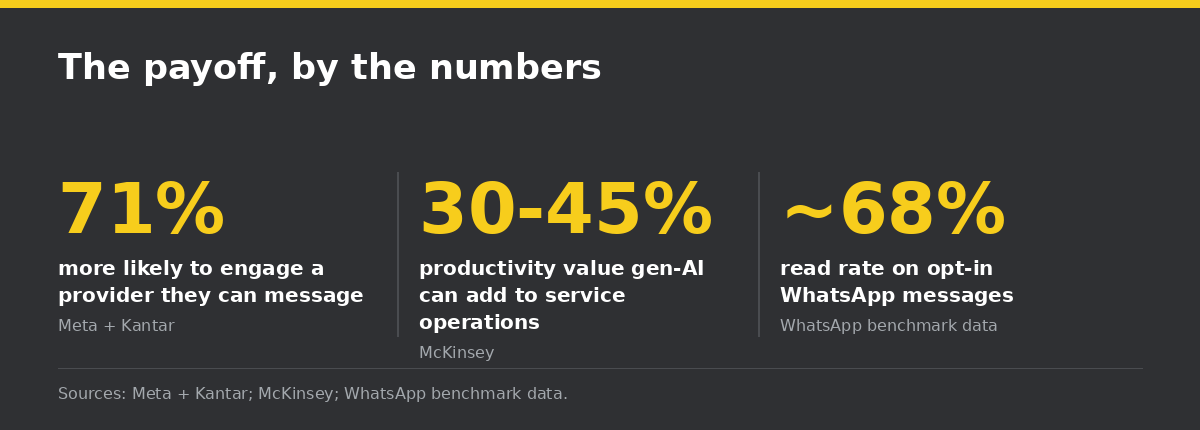
The payoff, by the numbers
Before the detail, here is why this is worth the team’s time:
That handset is the clinic's real booking channel. It is also its single biggest operational risk: one person holds the queue, nothing is auditable, the messages are invisible when she is on leave, and the gap between “patient asked for Thursday” and “Thursday is actually in the diary” is however long it takes her to get to it.
Hong Kong clinics rarely need convincing that patients want to book by message. What they need is a way to do it that does not put a second, unsynchronised diary inside a chat app. That means answering three questions honestly: where does the booking get captured, where does availability come from, and who confirms it.
This guide walks through the three architectures clinics actually use, the calendar-sync problem that decides which one is viable, and the consent rules that apply before any of it goes live.
Every WhatsApp booking setup is one of three patterns, or a deliberate mix of them. They differ in how much the patient does, how much the front desk does, and how much can go wrong silently.
Link-out to a booking page. The chat answers, then sends a link to the existing online booking system. Cheapest to build because the booking engine already exists, and the calendar is authoritative because the patient books directly into it. The cost is drop-off: every hop out of the chat loses people, particularly older patients on small screens.
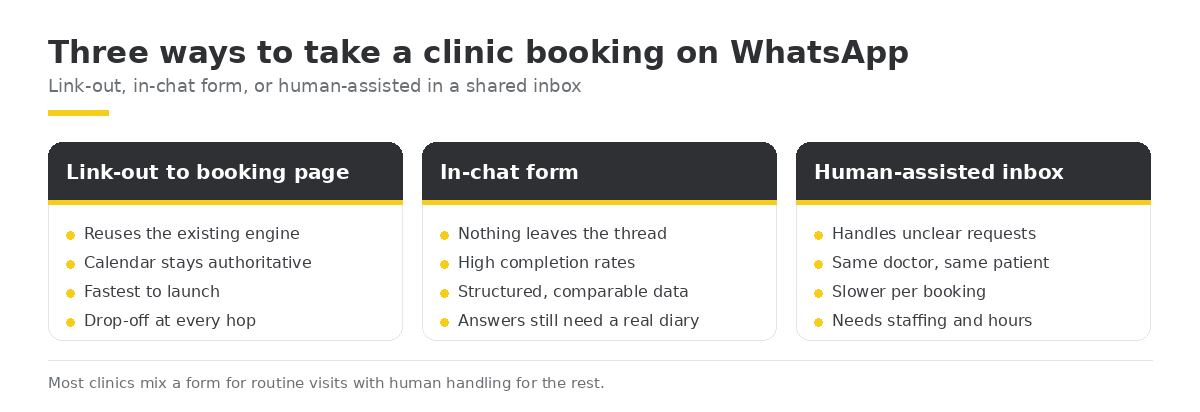
In-chat form. The patient completes a structured sequence inside WhatsApp — service, preferred doctor, preferred window, name and contact — using WhatsApp Flows or an interactive message sequence. Nothing leaves the thread, which is why completion rates are high. The complexity moves into your side: the form's answers still have to become a real appointment in a real diary.
Human-assisted booking in a shared inbox. The message lands in a queue that several trained staff can see. Staff read the request, check the diary, and confirm. Slower per booking and it does not scale infinitely, but it handles the messy 20 per cent — the patient who is not sure which specialty they need, the one describing symptoms, the one who wants the same doctor as last time.
Most Hong Kong clinics end up with a mix: an in-chat form for routine repeat consultations, human handling for anything else, and a shared inbox underneath both so nothing sits unread. The mistake is choosing the fully automated path for a practice whose bookings are mostly judgement calls.
Sending messages is solved. Knowing whether 15:30 on Thursday is genuinely free — after the walk-in that was added ten minutes ago, the doctor's blocked admin hour, and the patient who is mid-way through booking the same slot — is where systems fail.
Three properties decide whether your setup survives a busy week.
| Property | What it means | What happens without it |
|---|---|---|
| Read direction | The flow can see live availability, not a cached copy | Patients are offered slots that are already taken |
| Write direction | A confirmed booking is created in the practice system automatically | Staff retype bookings; the diary lags the chat |
| Slot holds | The chosen slot is held briefly while the patient confirms | Two patients book the same slot minutes apart |
| Cancellation write-back | A cancellation in chat frees the slot in the diary | Slots stay blocked and cannot be refilled |
| Identity match | The chat contact is matched to the patient record | Duplicate patient records accumulate quietly |
If your practice-management system has no interface for any of this, be honest about it early. A half-synced booking flow is worse than a well-run shared inbox, because it looks automated and quietly is not. In that situation the right first step is the shared inbox with a fast manual confirm, and integration later.
Identity matching deserves particular attention in Hong Kong. Patients message from a number that may not be the one on file, sometimes on behalf of a parent or a child. A booking flow that creates a new patient record for every new phone number will pollute the database within a month. Match on the number, then confirm identity in the conversation before writing anything.
A booking conversation has a shape. Getting the shape right removes most of the back-and-forth that makes messaging feel slower than the phone.
Acknowledge immediately. An automatic first reply that states what happens next and by when costs nothing and stops the follow-up “hello?” message ten minutes later.

Offer a small number of real slots. Three options, drawn from live availability, beat an open question about preferred times. Open questions produce answers your diary cannot satisfy.
Hold, then confirm. Hold the chosen slot for a short window while the patient confirms, and say so in the message. The hold is what prevents the double-booking that erodes trust in the whole channel.
Send one clean confirmation. Date, time, doctor, address and what to bring, in one message the patient can find again by scrolling. Two-thirds of “where do I go?” questions come from a confirmation split across four messages.
Give a one-tap reschedule path. The purpose of messaging is not only to book; it is to make changing the booking easy enough that a patient does it instead of silently not turning up. Pair it with a reminder sequence before the visit.
One structural detail shapes all of the above. On the WhatsApp Business Platform, a business can reply freely within a 24-hour window after the patient's last message; outside that window the clinic must use an approved template. Booking conversations mostly happen inside the window. Reminders and confirmations sent days ahead are Utility templates tied to the booking, which is a different category from marketing content — mixing the two is the most common reason a clinic's templates are rejected.
The Personal Data (Privacy) Ordinance (Cap. 486) sets six data protection principles covering collection, accuracy, retention, use, security and access. Using a patient's number to confirm the appointment they just requested is plainly within the purpose of collection. Using the same list to promote a health screening package is direct marketing, and the Ordinance sets specific requirements for that, including a clear opt-out.
There is a second layer in a clinical setting. The Medical Council of Hong Kong's Code of Professional Conduct restricts how registered doctors may promote their practice, so promotional broadcasts need review that a booking confirmation does not. Booking, confirming and reminding are service communications. Anything that reads as advertising should be checked against the Code first.
| What you must be able to show | How it is evidenced |
|---|---|
| The patient agreed to be contacted on this channel | A timestamped consent record with the capture route |
| The message was within the purpose of collection | Content tied to a real booking, not promotion |
| Only authorised staff saw the conversation | Named user accounts with role-based permissions |
| Records were kept for a defined period | A documented retention policy applied automatically |
| A patient can obtain or correct their data | A repeatable access and correction process |
| Promotional content was reviewed | Sign-off against the Medical Council Code before sending |
imBee provides named-user access control, role-based permissions, retention settings and audit logging, and is an Official Meta Technology Partner running an ISO/IEC 27001 certified information-security programme. The clinic remains the data user under the Ordinance and sets its own policies; no platform assumes that responsibility for you.
Booking by message increases contact volume before it reduces workload. Plan the first month around that fact.
Start with one appointment type and one doctor. Routine repeat consultations give you a clean read on volume and on how often the automated path is not enough.

Put every message in a shared inbox from day one. Even if the clinic keeps a manual confirm step, the queue must be visible to more than one person, with assignment and a named account per staff member. This is the change that survives holidays and resignations.
Publish your hours in the automatic reply. Patients message at 23:00. A clear “we reply from 09:00; for urgent matters call this number” converts a silence into a managed expectation.
Write the escalation rule before launch. Decide, in writing, what a staff member does when a booking message describes symptoms. Chat is a booking channel, not a triage channel, and the boundary must be explicit.
Run both languages from the start. Traditional Chinese and English templates in the same library, so the patient's language does not decide the quality of service. Related reading: patient messaging beyond SMS.
Review after four weeks against slot utilisation. Not messages handled. The number that matters is whether more of the diary is filled and whether cancellations are arriving early enough to refill. If you want that setup mapped against your practice system, talk to the imBee team.
A booking flow changes how appointments are made. It does not change how many appointments exist, and it cannot resolve clinical questions.
It will not create capacity. If the practice is genuinely full, faster booking produces a faster-filling waiting list and a more visible queue. That is useful information, not extra capacity.
It will not triage. Patients describe symptoms in booking messages because that is what is on their mind. Automated flows must not interpret them, and staff need a written rule for when to move a conversation to a clinician or a phone call.
It will not fix a practice system with no interface. If bookings cannot be written back automatically, someone is still retyping. Choose the shared-inbox pattern deliberately rather than pretending the integration exists.
It will not rescue a no-show problem caused by long booking horizons. Patients booked eight weeks out drop off regardless of channel. Shortening the horizon for high-demand slots does more than any message.
| Symptom | Likely cause | Where the fix sits |
|---|---|---|
| Double-booked slots | No slot hold during confirmation | Booking flow design |
| Diary lags the chat | No write-back to the practice system | Integration, or a manual confirm step |
| Duplicate patient records | New record created per phone number | Identity matching before write |
| Front desk overwhelmed | One channel, one person, no queue | Shared inbox with assignment |
| Patients still miss appointments | Booking horizon too long | Scheduling policy, not messaging |
Set against that list, the case is clear enough. A WhatsApp booking flow is the right fix for a clinic whose patients already message, whose front desk is retyping, and whose diary and chat contradict each other. It is the wrong fix for a shortage of consultation hours.
What is a clinic booking system in Hong Kong?
It is the system that captures an appointment request, checks real availability, reserves the slot and writes the confirmed booking into the clinic's diary. In Hong Kong most requests now arrive by messaging, so a booking system increasingly means a WhatsApp flow or shared inbox connected to the practice-management system rather than a phone line and a paper diary.
Can patients book appointments directly on WhatsApp?
Yes. Patients can complete a structured booking sequence inside the chat using WhatsApp Flows or interactive messages, be sent to an existing booking page, or be handled by staff in a shared inbox. What matters is whether the confirmed booking is written back into the clinic diary automatically, or whether someone is still retyping it.
How does WhatsApp booking connect to our existing practice system?
Through an interface that reads live availability and writes the confirmed appointment back. If your practice-management system has no such interface, a shared inbox with a fast manual confirmation is the honest option. A partially synced flow is worse than a manual one because it looks automated while the diary quietly falls behind.
How do we stop two patients booking the same slot?
Hold the slot while the patient confirms. Without a short reservation window, two people can select the same time minutes apart and both receive a confirmation. The hold should be visible in the message so the patient knows the offer expires, which also encourages a faster reply.
Do we need patient consent before messaging about an appointment?
Yes. Under Hong Kong's Personal Data (Privacy) Ordinance (Cap. 486) you need a record of the patient's agreement to be contacted, and the message must stay within the purpose the data was collected for. Confirming a booking the patient requested is service communication; promoting a screening package is direct marketing with separate requirements.
What is the 24-hour window on the WhatsApp Business Platform?
After a patient sends a message, the clinic can reply with free-form messages for 24 hours. Outside that window the clinic must use an approved template. Booking conversations usually happen inside the window, while reminders and confirmations sent days in advance are Utility templates tied to the appointment.
Can a booking chatbot handle patients describing symptoms?
It should not interpret them. Patients often describe symptoms when requesting an appointment, and an automated flow must route those conversations to a human rather than answer them. Write the escalation rule before launch so staff know exactly when to move a conversation to a clinician or a phone call.
Does WhatsApp booking work in both Chinese and English?
It should, and in Hong Kong that means Traditional Chinese and English in the same template library and the same inbox. Running one language properly and the other as an afterthought produces two different standards of service, and it usually shows up first in the confirmation message, where clarity matters most.

Kelly S.
Content Team Lead, imBee
Kelly S. owns content strategy, product positioning, and customer education at imBee. Previously, Kelly led B2B SaaS content programs and supported go-to-market initiatives for customer engagement products. On the imBee blog, Kelly covers conversational commerce, omnichannel messaging, WhatsApp Business, customer experience, and strategies for scaling business communications.
Questions about anything in this article? Talk to our team.