Why Regulated Teams Cannot Deploy a Generic Chatbot
What Does Governed AI Actually Mean in Customer Service?
The Three Deployment Patterns, Compared Honestly
What to Look For When Evaluating a Governed AI Assistant
Consent, Records and Privacy: The Obligations Behind the Deployment
How to Roll Out Governed AI Without Losing Control of the Inbox
What Governed AI Cannot Fix
A specialist clinic in Sheung Wan and a children's charity in Sham Shui Po were given the same instruction last quarter: use AI to answer more of the inbound messages, because the team cannot keep up. Both looked at the same category of product. Both stopped at the same question, which no vendor demo answered: what happens the first time the assistant says something it should not have said?
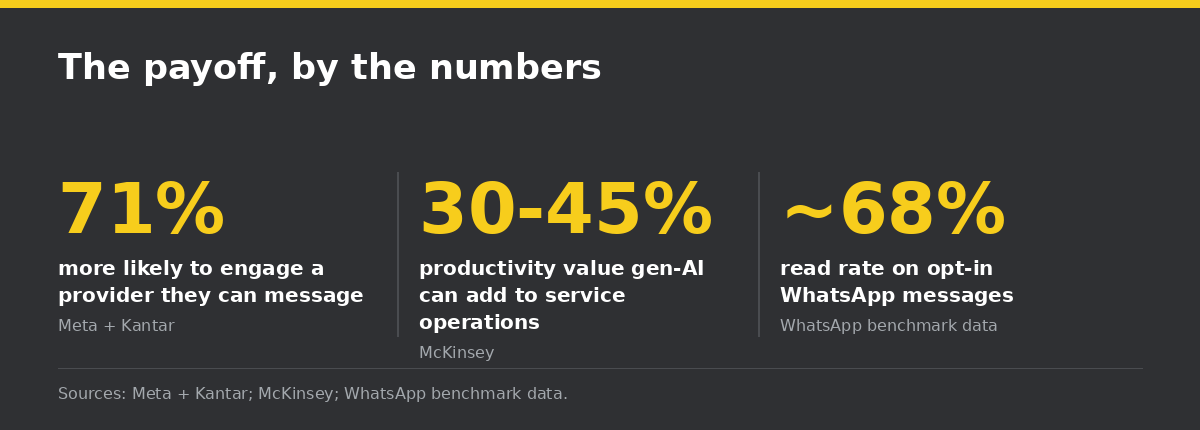
The payoff, by the numbers
Before the detail, here is why this is worth the team’s time:
For the clinic, the risk is an assistant that drifts from logistics into anything resembling clinical advice, or that repeats a patient's condition into a thread the patient shares with family. For the charity, it is an assistant that answers a question about how a donation is used with a number nobody in the finance team has approved, or that treats a distressed supporter message as a routine ticket.
Neither risk is exotic. Both are the predictable behaviour of a general-purpose model asked to be helpful without being told where its authority stops. That is the gap governed AI is designed to close: not a smarter model, but a narrower one, wrapped in controls that make its behaviour reviewable after the fact.
This matters more in Hong Kong and Singapore than the global vendor pitch suggests, because the reviewing party is rarely a regulator first. It is usually a board member, a professional indemnity insurer, or a major donor asking a pointed question about how their data was handled. The organisation has to be able to answer it from records, not from memory.
Most teams meet AI customer service as a single toggle: turn the assistant on, watch it answer. A governed deployment separates that into layers, each of which can be inspected and changed independently.
Grounding. The assistant answers from a defined, versioned source set — your published policies, service pages, opening hours, programme descriptions — rather than from general world knowledge. If the answer is not in the source set, the correct behaviour is to say so and hand over, not to improvise a plausible one.
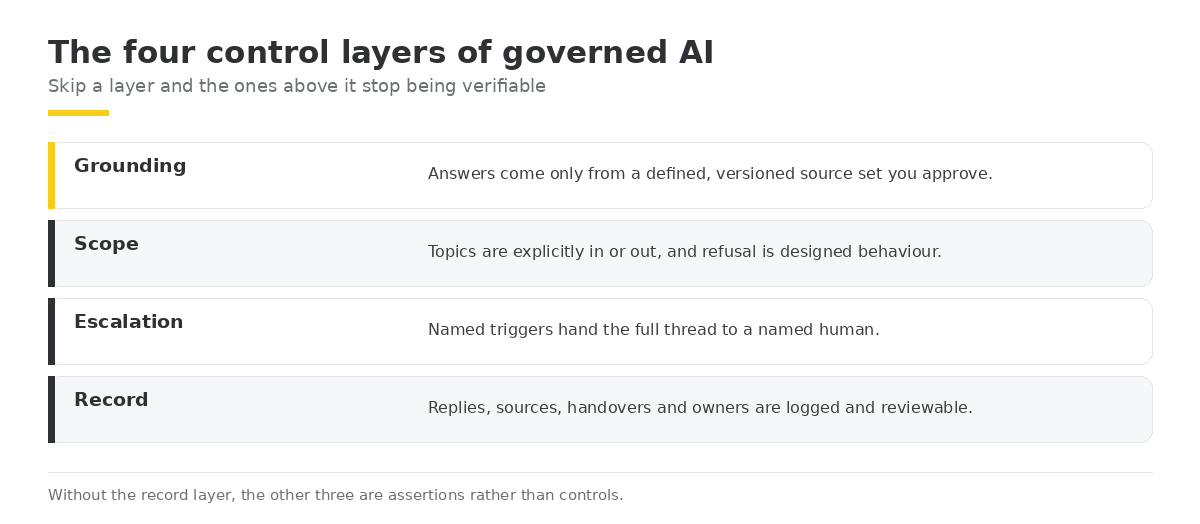
Scope. Topics are explicitly in or out. A clinic assistant can confirm what to bring to an appointment; it must refuse to interpret a symptom. A charity assistant can explain how to set up a monthly gift; it must not answer a question about a specific beneficiary case. Refusal is a designed behaviour, not a failure.
Escalation. Defined triggers hand the conversation to a named human — a distress signal, a complaint, a request the assistant cannot ground, a repeated question that suggests the first answer did not land. The handover has to carry the full thread, not restart the conversation.
Record. Every reply the assistant sent, the sources it used, the point of handover and the person who took it are logged. Without this layer the other three are assertions rather than controls, because nobody can show what actually happened in a specific conversation on a specific day.
imBee AI is built to sit inside these boundaries rather than around them: replies are grounded in the guidelines the organisation supplies, and the conversation stays in a shared inbox where a human can take it over mid-thread.
Vendors tend to present these as a ladder you climb. In regulated work they are better understood as three options with different failure modes, and mature teams often run more than one at the same time for different message types.
| Pattern | 運作原理 | Where it fits | Main risk |
|---|---|---|---|
| Agent-assist | AI drafts, a human edits and sends every message | Clinical, casework, complaints, major-donor correspondence | Slower; benefit depends on draft quality |
| Human-in-the-loop | AI answers routine topics; defined triggers hand to a human | Appointment logistics, donation mechanics, opening hours | Trigger design; a missed trigger looks like a good answer |
| Full autonomy | AI answers end to end with no routine human review | Narrow, low-stakes, high-volume queries only | Silent drift; errors surface only when someone complains |
The honest reading is that full autonomy is rarely appropriate for a first deployment in healthcare or the charity sector, and that agent-assist is undervalued. Agent-assist produces almost all of the speed benefit on complex messages while leaving accountability exactly where it already sits — with the named person who presses send.
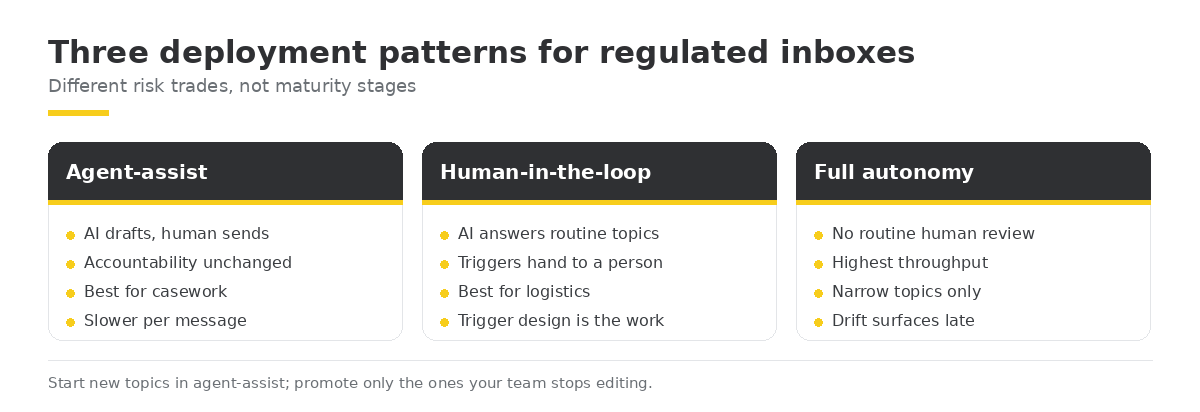
Human-in-the-loop is where most organisations land for the bulk of routine traffic, and it is also where the design work is. The quality of a human-in-the-loop deployment is decided almost entirely by the escalation triggers, not by the model. A trigger set written in an afternoon will let through exactly the conversations you most wanted a person to see.
A practical sequencing rule: start every new topic in agent-assist, watch the drafts your team accepts without editing, and promote only those topics to human-in-the-loop. The edit rate is a far better readiness signal than any accuracy score a vendor quotes.
Run every shortlisted product through the same set of questions, and insist on seeing the answer in the product rather than in a slide.
Can you see the sources behind a specific reply? Not the source library in general — the sources used in one named conversation, after the fact.
Can you define topics the assistant must refuse? And can you test a refusal before launch, rather than discovering the boundary in production?
Are escalation triggers configurable by your team? If a trigger change is a vendor ticket, your controls move at the vendor's speed, not yours.
Does handover carry the whole thread? A human who receives a bare alert has to ask the person to repeat themselves, which is precisely the experience the deployment was meant to avoid.
Is access controlled per named user, with roles? Shared logins make it impossible to say who read a patient's or a supporter's information.
Can you set retention and deletion? Conversations should age out under a policy you set, not accumulate by default.
Does it work in the languages your community uses? In Hong Kong that usually means Traditional Chinese and English in the same thread, with no drop in grounding quality when the language switches.
Where is the data processed and stored? You need a straight answer for your privacy notice and your board.
An AI assistant handling patient or donor messages is processing personal data, and in a clinical or casework context that data is sensitive by nature. The obligations sit with your organisation as the data user or data controller, whatever the platform does on your behalf.
In Hong Kong, the Personal Data (Privacy) Ordinance (Cap. 486) sets out six data protection principles covering collection, accuracy and retention, use, security, transparency and access. Answering a question about an appointment the patient booked is a use directly related to the purpose of collection. Using the same conversation history to promote an unrelated service is direct marketing, which the Ordinance treats separately and which requires the individual to be able to opt out.
In Singapore, the Personal Data Protection Act applies alongside the Do Not Call provisions, with consent, purpose limitation, notification and accountability obligations. Charities also answer to the Commissioner of Charities on governance, and healthcare providers to the Ministry of Health on service standards, so the same conversation record can be relevant to more than one reviewer.
| Question you will be asked | What you need to be able to produce |
|---|---|
| Did this person consent to be messaged? | A timestamped consent record and the route it came through |
| Was this reply within the stated purpose? | The topic scope in force on that date, and the reply itself |
| What did the assistant base this answer on? | The grounded sources used for that specific reply |
| Who took over, and when? | An escalation log with named user accounts |
| How long is this kept? | A documented retention period, applied automatically |
| Can we erase this on request? | A retrieval and deletion process that covers AI-handled threads |
imBee provides role-based access, retention controls and audit logging so an organisation can support these obligations, and imBee holds ISO/IEC 27001 certification for its information-security programme. imBee is an Official Meta Technology Partner for the WhatsApp Business Platform. Your organisation remains the accountable party and sets its own policies; no platform discharges that duty on your behalf.
Deployments rarely fail on model quality. They fail because nobody agreed the boundary before launch, and because the escalation path pointed at a mailbox rather than a person.
Write the scope document first. One page: topics in, topics explicitly out, and the exact wording of the refusal. If your clinical lead or programme director will not sign that page, you are not ready to switch anything on.
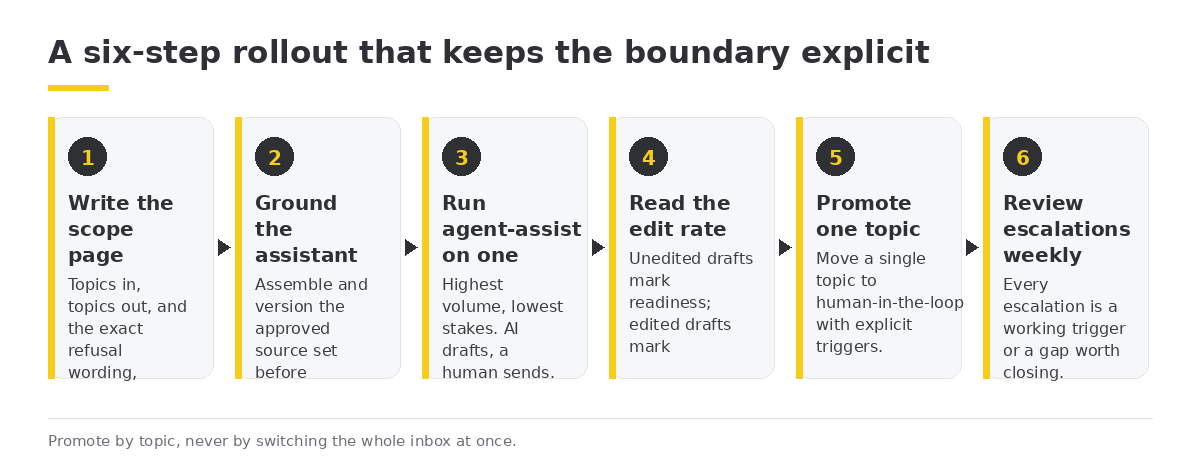
Ground before you generate. Assemble the approved source set and version it. Anything the assistant might be asked that is not in that set is either a source to add or a topic to refuse.
Start in agent-assist on one topic. Pick the highest-volume, lowest-stakes question your team answers — parking and access, donation receipts, opening hours. Let the AI draft and a human send.
Read the edits, not the accuracy score. After two weeks, look at what your team changed before sending. Drafts accepted unedited mark the topics ready to promote; heavily edited drafts mark the gaps in your source set.
Then promote one topic, not all of them. Move a single well-understood topic to human-in-the-loop with explicit escalation triggers, and keep everything else in agent-assist.
Review escalations weekly for the first quarter. Every escalation is either a trigger working correctly or a gap in the source set. Both are useful; neither is visible unless someone reads them.
If you want a walkthrough against your own message mix, the imBee team can run through it with you at imbee.io/contact-us.
Governed AI is a strong answer to a specific problem: too many routine inquiries, answered inconsistently, by a team that cannot grow at the rate the inbox does. It does not address several problems it is regularly bought to solve.
It does not fix a policy nobody has written down. An assistant grounded in sources can only be as clear as those sources. If three colleagues answer the same question three ways today, AI will not resolve the disagreement — it will scale one of the three answers and make the inconsistency more visible.
It does not fix understaffing on complex work. Routine volume is where the capacity comes back. Casework, clinical judgement and major-donor relationships still need the same people and the same time, and the honest business case says so.
It does not remove accountability. If an assistant sends the wrong thing, the organisation answers for it. That is why grounding, scope and logging are procurement criteria and not features to be enabled later.
It does not fix consent you never captured. An assistant cannot message people who have not agreed to be messaged. Where reach is the constraint, better opt-in capture at the point of booking or donation will do more than any model change.
It does not replace a distress pathway. The person whose message needs a human within the hour is the reason escalation triggers exist. Design that path first and test it deliberately, including out of hours.
| Symptom after launch | Likely cause | Where the fix actually sits |
|---|---|---|
| Confident but wrong answers | Thin or outdated source set | Content governance, not the model |
| Escalations that arrive too late | Triggers written for obvious cases only | Trigger review against real transcripts |
| Team ignores the AI drafts | Drafts not grounded in how the team really answers | Retrain on approved past replies |
| Complaints about tone | Refusal wording written by the vendor | Rewrite refusals in your own voice |
| Cannot answer an audit question | Logging switched on after launch | Enable audit logging before the first live message |
Set these limits out in the business case. A governed assistant that handles routine inquiries reliably, refuses cleanly and escalates early is a substantial operational gain. Promising more than that is how a promising deployment gets switched off six months in.
What is governed AI in customer service?
Governed AI is an assistant constrained by four explicit controls: it answers only from an approved source set, operates inside defined topic boundaries, escalates to a named human on defined triggers, and logs every reply with the sources behind it. The point is not a smarter model but a narrower one whose behaviour can be reviewed after the fact.
Is it safe to use AI for patient inquiries?
It is workable for logistics and administration when scope is tightly drawn — appointment details, preparation instructions, what to bring, opening hours. Anything that touches clinical judgement should be an explicit refusal that hands to a clinician. The safety of the deployment depends on the boundary and the escalation path, not on the model's general capability.
What is the difference between agent-assist and full automation?
In agent-assist the AI drafts a reply and a named person edits and sends it, so accountability stays exactly where it already sits. In full automation the assistant answers end to end with no routine human review, which suits only narrow, high-volume, low-stakes questions. Most regulated teams run agent-assist and human-in-the-loop side by side.
Can AI handle donor questions for a charity?
Yes for the mechanics — how to set up a monthly gift, how to get a receipt, how to change an amount — provided the answers are grounded in approved published material. Questions about a specific beneficiary, a complaint, or how funds are allocated should escalate to a person, because those answers carry reputational and governance weight.
What does the PDPO require when AI handles customer conversations?
The Personal Data (Privacy) Ordinance (Cap. 486) applies to the conversation exactly as it would to a human-handled one: collect for a stated purpose, use it only for that purpose or a directly related one, keep it accurate and no longer than necessary, secure it, and give the individual access. Direct marketing carries separate opt-out requirements.
How do we prove what the AI told a customer?
You need reply-level logging that captures the message sent, the grounded sources used for that reply, the time, and the point at which a human took over. Log at launch rather than after an incident, because retrofitted logging cannot reconstruct conversations that have already happened.
Do we need consent before an AI assistant messages someone?
You need the same consent you would need to message them at all. The assistant does not create a new permission. Where the channel is WhatsApp, an opt-in is required and service messages are treated differently from marketing content, so the consent record should show both the route and the scope the person agreed to.
How long does a governed AI rollout take?
The technical setup is rarely the constraint. Agreeing the scope document, assembling and versioning the source set, and designing escalation triggers usually take longer than the configuration, and skipping them is what produces a deployment that gets switched off. Plan for a topic-by-topic rollout across a quarter rather than a single launch date.

Kelly S.
Content Team Lead, imBee
Kelly S. owns content strategy, product positioning, and customer education at imBee. Previously, Kelly led B2B SaaS content programs and supported go-to-market initiatives for customer engagement products. On the imBee blog, Kelly covers conversational commerce, omnichannel messaging, WhatsApp Business, customer experience, and strategies for scaling business communications.
Questions about anything in this article? Talk to our team.