Why do donors ignore your emails but open WhatsApp?
What can an NGO actually send donors on WhatsApp?
How do you send a tax-ready donation receipt on WhatsApp?
How do you stop recurring gifts from quietly lapsing?
Is a fundraising appeal 'direct marketing' under the PDPO?
How do you run donor messaging without losing control of donor data?
常見問題
Ask a fundraising director where donations leak and the answer is rarely the first gift. It is everything after it. The receipt lands in a spam folder. The impact report goes unopened. A monthly donor's card expires in March and nobody notices until the year-end reconciliation. That donor never decided to leave. They simply stopped hearing from you somewhere they actually look.
Email still does the heavy lifting for most charities in Hong Kong and Singapore, and it should stay in the mix. But it is a poor fit for the moments that decide whether someone gives a second time: the thank-you, the tax receipt, the failed payment, the short note that reminds a supporter why they gave at all. Those are conversations, not campaigns, and conversations belong where your donors already spend their day.
The payoff, by the numbers
Moving donor moments onto an opt-in messaging channel changes the odds on every message you send.

重點摘要
Charities often arrive at WhatsApp thinking of it as a louder megaphone for the year-end appeal. That is the least interesting thing it does, and the fastest way to get muted. The channel earns its keep across the whole donor lifecycle, where most of your retention is quietly won or lost.
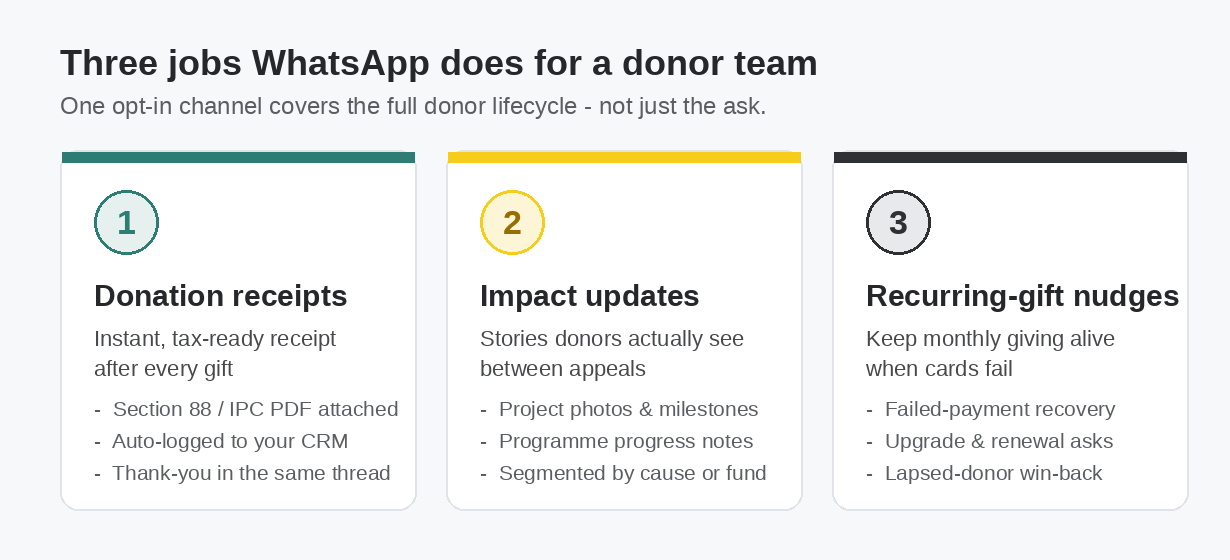
The distinction that matters most is the one Meta already builds into the WhatsApp Business Platform template categories. A receipt or a payment-failure notice is a utility message tied to a transaction the donor already initiated. An appeal, a campaign launch or an upgrade ask is a marketing message, and in Hong Kong it carries consent obligations that a receipt does not. Sorting your messages into the right category is not an administrative chore. It is the line between a compliant programme and a criminal offence under the PDPO.
| Donor moment | What you send | Template category | Timing |
|---|---|---|---|
| Gift received | Receipt and thank-you, PDF attached | 實用性 | Within minutes |
| Recurring payment failed | Heads-up and one-tap link to update payment | 實用性 | Same day |
| Programme milestone | Photo and a two-line impact note | 市場營銷 | Monthly or quarterly |
| Year-end or disaster appeal | Campaign message with a give link | 市場營銷 | Seasonal, consent required |
| Event or volunteer shift | Time, place, what to bring | 實用性 | 24 to 48 hours before |
| Lapsed donor | Personal note, option to pause or lower the tier | 市場營銷 | Day 20 onward |
If you are still deciding whether you need the API at all, our guide to the WhatsApp Business app versus the API versus the Platform covers the trade-offs. The short version for charities: the free app cannot give you templates, consent records, or an audit trail, and those three things are exactly what a donor programme needs.
The receipt is the most underrated message a charity sends. It is the one communication a donor is actively waiting for, it arrives at the moment of peak goodwill, and in both Hong Kong and Singapore it has real monetary value to the person receiving it. Sending it instantly, on a channel they read, is the cheapest retention work available to you.
In Hong Kong, a donation is only deductible if it goes to a charity that is exempt from tax under section 88 of the Inland Revenue Ordinance, or to the Government for charitable purposes. The aggregate deduction cannot be less than HK$100 and cannot exceed 35% of the donor's income after allowable expenses and depreciation allowances, or of assessable profits. Your receipt is the document that makes that claim possible, so it needs to carry the charity's name, its section 88 reference, the date, the amount, and a clear statement that the sum was a donation.
Singapore works differently and more generously. Only an Institution of a Public Character, approved by the Commissioner of Charities, can issue tax-deductible receipts. Outright cash donations to an approved IPC that give the donor no material benefit attract a 250% tax deduction, a rate extended through 31 December 2026. Donors do not usually claim it themselves: IPCs transmit donation records to IRAS, and the deduction is auto-included in the donor's assessment. That makes the accuracy of the identifier you capture at the point of giving unusually important.
| 香港 | 新加坡 | |
|---|---|---|
| Who can issue a deductible receipt | Charity exempt under s.88, Inland Revenue Ordinance (Cap. 112) | Institution of a Public Character approved by the Commissioner of Charities |
| Donor threshold | Aggregate donations of at least HK$100 | Outright cash gift with no material benefit to the donor |
| Deduction | Up to 35% of assessable income or profits | 250% of the donation, extended through 31 Dec 2026 |
| How the donor claims | Claims in their own tax return, using your receipt | Auto-included by IRAS from records the IPC submits |
| What the message should carry | Charity name, s.88 reference, date, amount, donation statement | IPC name, date, amount, and the identifier used for auto-inclusion |
Operationally this is a document message on an approved utility template, triggered by your payment gateway or CRM the moment a gift clears. The donor gets a thank-you and a PDF in the same thread they will use next time they have a question, and your finance team gets a logged, timestamped record instead of a re-send request three months later.
Ask most charities where their monthly giving programme leaks and they will point to donors who cancelled. The bigger number is usually the donors who never cancelled at all. A card expires, an issuer declines a transaction, a bank reissues a number after a fraud alert, and the gift simply stops. Nobody made a decision. The relationship ended through an administrative accident, and the donor often does not know it happened.
This is the single highest-return use of messaging for a donor team, because the donor has already said yes. You are not asking for a new commitment. You are removing a piece of friction that is standing between someone and the thing they already chose to do. Tone decides whether it works. A payment-failure notice that reads like a debt collection letter will lose you a supporter you had already won.
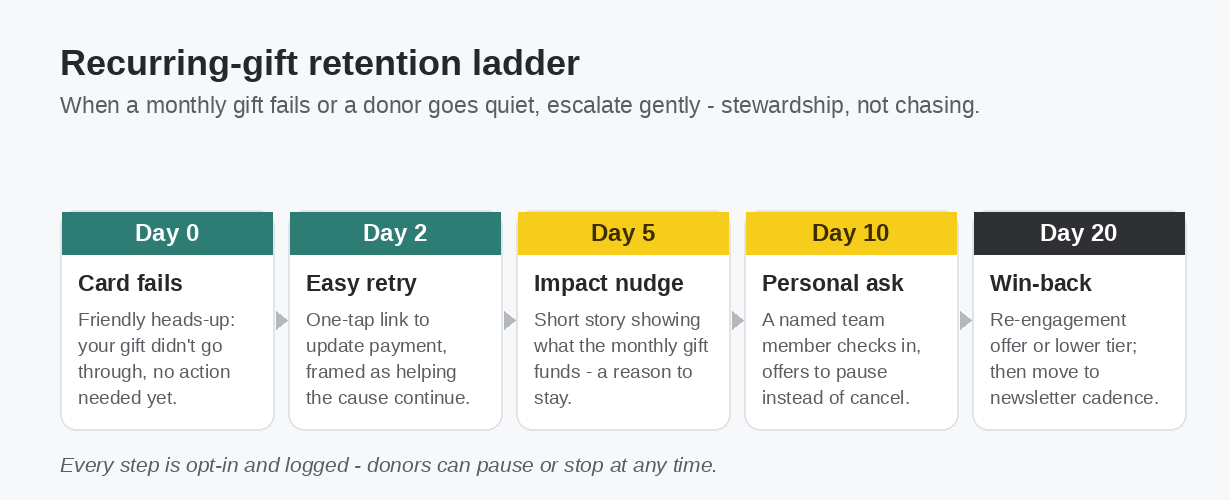
Two details make the ladder work. First, always offer pause before cancel. A donor whose circumstances changed will often take a three-month hold when the alternative presented is ending the gift entirely. Second, treat the impact nudge at day five as the real ask. The payment link is the mechanism, but the reason someone updates their card is that you reminded them what the gift does. Segment those messages properly, by cause or fund rather than by one undifferentiated list, using something like dynamic contact groups, and then measure which of them actually recovered the gift with broadcast analytics.
This is the question that stops many Hong Kong charities from using WhatsApp properly, and the answer is not the one people hope for. Yes. Under section 35A of the Personal Data (Privacy) Ordinance (Cap. 486), direct marketing expressly includes soliciting donations or contributions for charitable, cultural, philanthropic, recreational, political or other purposes. A fundraising appeal is direct marketing in law, even though nothing is being sold.
That has concrete consequences. Before you use a donor's personal data to send an appeal, you must inform them that you intend to do so, tell them the kinds of data you will use and the classes of marketing subjects involved, give them a channel to respond, and obtain their consent. Consent here can include an indication of no objection, but it must be actively provided, and the Privacy Commissioner's guidance on direct marketing is explicit that getting this wrong is a criminal offence, not a paperwork slip. If a donor later asks you to stop, you must stop.

The practical model is a clean separation. A receipt for a gift the donor just made is a transactional message flowing from the purpose you collected the data for, disclosed in your Personal Information Collection Statement under Data Protection Principle 1. An appeal is a marketing message that needs its own consent, its own record, and its own one-tap way out. Keep both, but do not let them share a consent flag, because DPP3 limits you to the purpose you actually collected the data for.
Singapore charities face a parallel regime. The Personal Data Protection Commission administers the PDPA, which requires consent for collection and use and layers Do Not Call obligations on top for marketing sent to Singapore numbers. The details differ from Hong Kong's; the instinct should not. Capture consent once, record it properly, and honour a withdrawal the day it arrives.
Everything above is achievable with a phone and enough discipline, right up until the moment it is not. The failure mode is predictable. Donor conversations sit on a fundraiser's personal handset, so when they leave, the relationship and the consent record leave with them. Nobody can prove which donor agreed to what. Two team members message the same major donor in the same week. An appeal goes to someone who opted out in March.
A governed operating model fixes this by moving donor conversations off individual phones and into a shared, permissioned system. In practice that means a single WhatsApp Business account the organisation owns, an approved template library so nobody improvises an appeal, role-based access so a volunteer coordinator cannot see major-donor records, and an audit trail that captures every consent, every template version, and every opt-out. This is the same discipline that patient-messaging teams apply in healthcare, for the same reason: the data is sensitive and the obligations are personal.
imBee brings those donor conversations into one omnichannel inbox alongside WeChat, Instagram, SMS and web chat, with consent, templates and opt-outs held in a single governed record. imBee AI can draft replies and summarise long donor threads inside the guardrails your team sets, so a small fundraising office can answer quickly without letting an AI improvise a claim about how a gift will be used. As an Official Meta Technology Partner serving 10,000+ enterprises across 60+ industries, and with an ISO/IEC 27001 certified security programme, imBee is built for teams answering to the PCPD and to their own boards. Cost is worth modelling early, since conversation pricing differs by category — our WhatsApp API pricing guide breaks it down, and Meta publishes the current rates.
If you want to see what a donor programme looks like on a governed inbox, with receipts, appeals and consent handled separately, book a demo with imBee.
What is NGO donor communication on WhatsApp?
It is the use of an opt-in WhatsApp Business account to handle the donor lifecycle: sending instant donation receipts, sharing impact updates between appeals, and nudging recurring gifts that have failed or lapsed. In Hong Kong it operates under the PDPO, which treats fundraising appeals as direct marketing requiring the donor's prior consent.
Can a charity send donation receipts on WhatsApp?
Yes. A receipt is a transactional message tied to a gift the donor just made, sent as a document on an approved utility template. In Hong Kong the receipt should carry the charity's name, its section 88 reference, the date, the amount, and a statement that the sum was a donation, so the donor can claim their deduction.
Is a fundraising appeal on WhatsApp direct marketing under the PDPO?
Yes. Section 35A of the PDPO (Cap. 486) defines direct marketing to include soliciting donations for charitable purposes. Before sending an appeal you must notify the donor of your intention, describe the data and marketing subjects involved, provide a response channel, and obtain consent. Non-compliance is a criminal offence, not an administrative one.
Do we need the WhatsApp Business API, or is the free app enough?
The free WhatsApp Business app cannot give you message templates, consent records, multi-user access or an audit trail, and it caps broadcast lists tightly. A donor programme needs all four, which means the WhatsApp Business Platform (commonly called the API), accessed through a provider. The terms are often used interchangeably and describe the same underlying product.
How much does it cost to message donors on WhatsApp?
Meta prices business-initiated conversations by template category, so a utility message such as a receipt or payment-failure notice costs less than a marketing appeal. Costs vary by market. Model your volumes by category rather than by an average, because a receipt-heavy programme and an appeal-heavy programme price very differently.
How do we get donors to opt in?
Ask at the moment of the gift, on the donation form and the confirmation page, with a clear Personal Information Collection Statement explaining what you will send and how to stop. Separate the consent to receive receipts from the consent to receive appeals, because under the PDPO they are not the same permission.
What happens if a donor asks to stop?
You must stop, and you must be able to show that you stopped. Honour the opt-out across every channel and every list, record the date, and make sure a future campaign cannot pick that donor back up. This is why opt-out state belongs in a shared system rather than on one fundraiser's phone.
Can WhatsApp recover a failed recurring gift?
It is one of the strongest uses of the channel, because the donor has already committed and the only obstacle is friction. A same-day notice with a one-tap link to update payment details, followed by a gentle impact reminder a few days later, recovers gifts that would otherwise lapse silently and unnoticed.