Why Donor Conversations Keep Falling Out of the Database
What Is a Nonprofit CRM, and How Is It Different From a Fundraising Database?
The Four Ways APAC NGOs Actually Run Donor Data Today
What to Look for When Choosing a Nonprofit CRM
Consent, Receipts and Data Protection for Hong Kong and Singapore NGOs
How to Connect Messaging to the CRM Without Rebuilding Everything
What a Nonprofit CRM Cannot Fix
A mid-sized charity in Wan Chai runs a monthly-giving programme of a few thousand supporters. The donor database holds every gift, every receipt and every mailing address. It does not hold the WhatsApp thread where a long-standing donor asked to pause her contribution for three months, or the Facebook message where a corporate volunteer offered to bring twelve colleagues to the next beach clean.
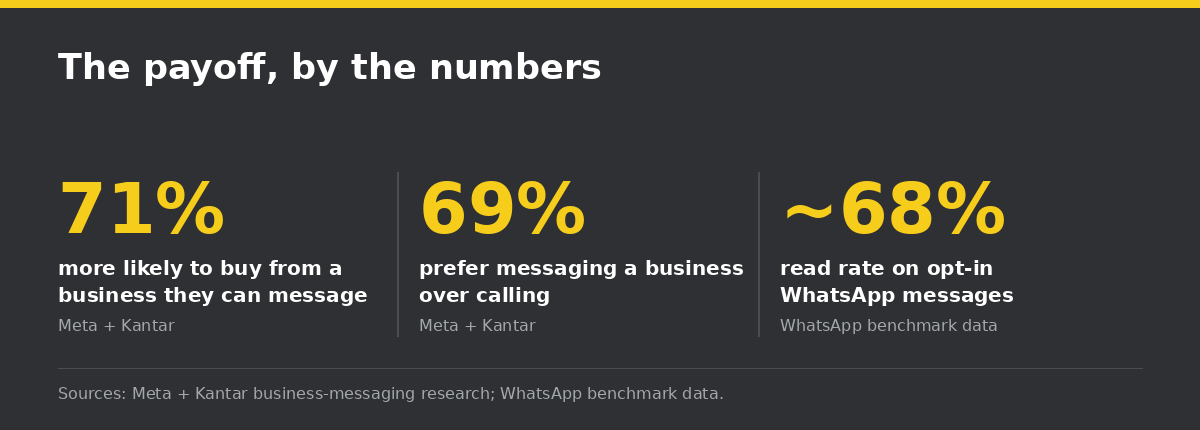
The payoff, by the numbers
Before the detail, here is why this is worth the team’s time:
Those conversations sit on a programme officer's phone. When she goes on leave, they are effectively gone. When the fundraising team runs its lapsed-donor appeal, the paused donor gets a reactivation message she has already answered, and the relationship takes a small, avoidable knock.
This is the gap that a nonprofit CRM is supposed to close, and the reason so many APAC NGOs feel their CRM is not working. The database is usually fine at recording money. It is the conversation, the consent and the context around the money that leak — and in a region where donors, volunteers and corporate partners overwhelmingly reach you on messaging apps, that is most of the relationship.
The practical question for a small development team is not which brand of CRM to buy. It is which system holds the supporter record, which system holds the conversation, and what has to be true for those two to stay in step without anyone retyping anything.
A nonprofit CRM — constituent relationship management — is the system of record for everyone connected to the organisation, not only the people who have given money. Donors, volunteers, beneficiaries where appropriate, corporate partners, event attendees and grant contacts all live in the same address book, with the relationships between them made explicit.
A fundraising database is narrower. It answers “who gave what, when, and did we receipt it?” That is essential and most charities run one, but it is a ledger with contact details attached, not a relationship system.
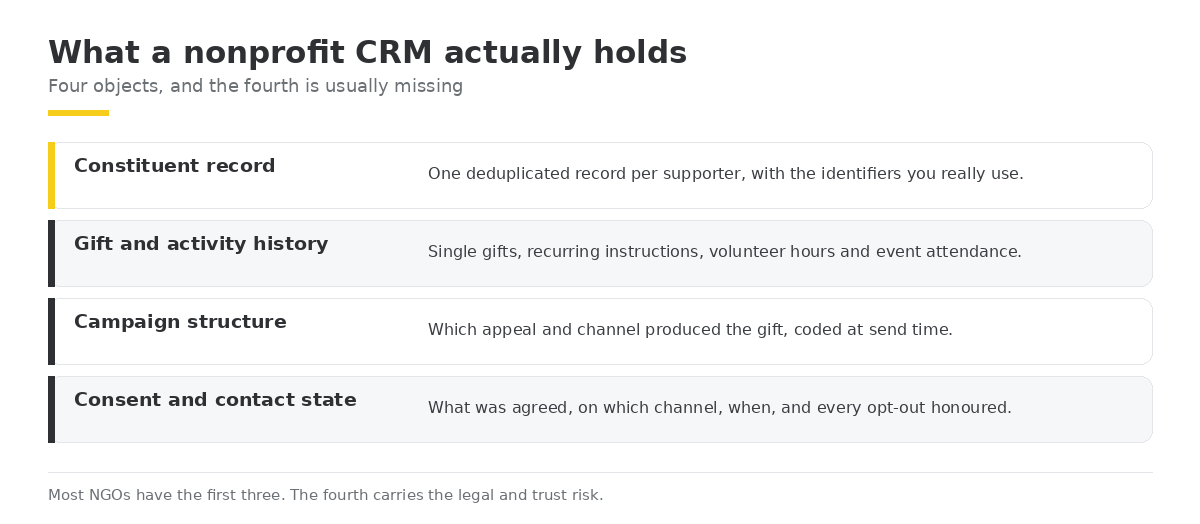
In practice a working nonprofit CRM holds four things, and the fourth is the one that is usually missing:
The constituent record. One row per human or organisation, deduplicated, with the identifiers you actually use to reach them — including the mobile number tied to their messaging app, not just a landline collected at an event in 2019.
The gift and activity history. Single gifts, recurring instructions, in-kind donations, volunteer hours, event attendance. This is what lets you tell a first-time donor from a lapsed monthly giver from a volunteer who has never given a dollar.
The campaign and appeal structure. Which appeal, channel and message produced the gift, so the team can stop guessing which of its three annual campaigns actually pays for itself.
The consent and contact state. What each supporter agreed to receive, on which channel, captured when and through which route — plus every opt-out, honoured across channels rather than only in the mailing tool where it was recorded.
Most NGOs in Hong Kong and Singapore have the first three in reasonable shape. The fourth is thin, and it is the one that carries both the legal risk and the day-to-day trust cost when a supporter who asked to be left alone gets an appeal anyway.
Before comparing products, it is worth being honest about which of these describes your organisation today, because the upgrade path is different for each.
The most common setup in the region is not a CRM at all. It is a spreadsheet of donors, a shared Gmail account, a mailing tool, and two or three staff phones carrying the actual relationships. That works at a few hundred supporters and quietly stops working somewhere between one and three thousand.
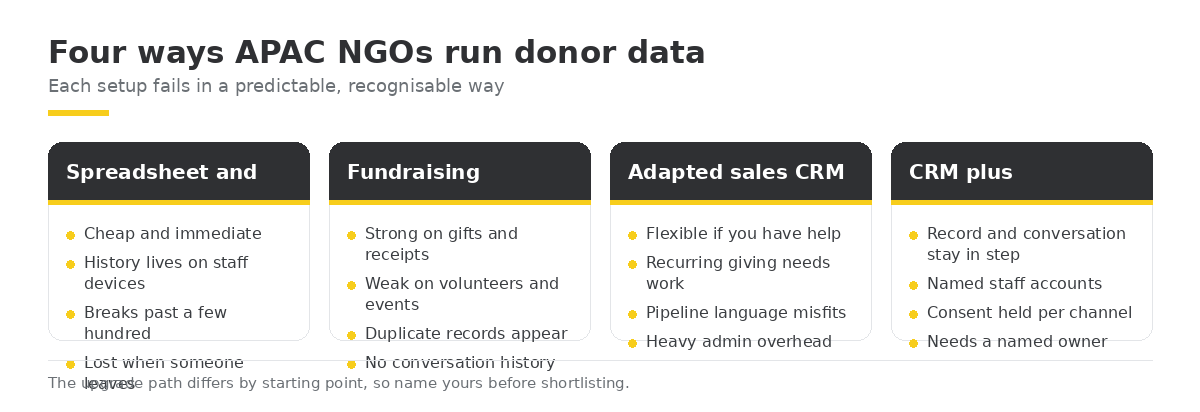
| Setup | Works when | Fails when | Typical first symptom |
|---|---|---|---|
| Spreadsheet plus staff phones | Under a few hundred supporters, one or two staff | Volume grows or a staff member leaves | Nobody can answer “when did we last speak to this donor?” |
| Fundraising database only | Giving is the whole relationship | Volunteers, events and enquiries matter too | Two records for the same person, one giving and one volunteering |
| Generic sales CRM adapted | You have technical help in-house | Recurring gifts, receipting and consent need custom work | Pipeline language that does not fit fundraising, and heavy admin |
| Nonprofit CRM plus a messaging layer | Supporters reach you on chat channels | Nobody owns the integration | Works, provided the conversation writes back to the record |
The fourth row is where most organisations are heading, and it is worth being precise about what it means. The CRM stays the system of record. A shared messaging inbox handles WhatsApp, Facebook, Instagram and web chat in one queue, with named staff accounts rather than a phone in someone's pocket. The two exchange the small number of facts that matter: who this person is, what they last asked for, what they consented to.
What you are buying with that arrangement is not a bigger database. It is the ability to answer a donor in the channel they used, and to have that exchange visible to the next person who opens the record.
Run every shortlisted option through the same set of questions, and insist on seeing the answer demonstrated rather than described.
Does it handle recurring giving properly? Monthly donors are the backbone of most sustainable APAC nonprofits. Pausing, resuming, changing the amount and changing the payment date must be routine operations, not a support ticket.
Does it store consent as a record with a history? You need to show what a supporter agreed to, when, and by what route — and to see the whole history, not just the current flag.
Can it deduplicate on the identifiers you actually hold? In Hong Kong that usually means a mobile number and an English plus Chinese name variant; matching on email alone will leave you with duplicate records within a year.
Does it produce the receipts and reports your auditors and regulator expect? Receipting, restricted-fund tracking and annual reporting are the compliance floor, not nice-to-haves.
Can messaging channels write back to it? If a WhatsApp conversation cannot update the supporter record, you have bought a filing cabinet with a chat window bolted to the side.
Does it work in the languages your supporters use? Traditional Chinese and English in the same record, the same inbox and the same template library, without a second system.
Can you get your data out? Ask to see an export before you sign, not after you want to leave.
One question that is usually skipped: who administers it after go-live? A nonprofit CRM with no named owner drifts within two quarters, whatever the software does.
Supporter data is personal data. In Hong Kong the Personal Data (Privacy) Ordinance (Cap. 486) applies to charities in the same way it applies to businesses, and its direct marketing provisions apply to fundraising appeals — asking someone for money is promotional communication, whatever the cause. In Singapore, the Personal Data Protection Act and the Do Not Call provisions apply alongside the Charities Act framework overseen by the Commissioner of Charities.
Two distinctions do most of the work in practice. The first is between a service message and an appeal: a receipt, a confirmation of a monthly gift, or a reply to a question the supporter asked is transactional. A campaign asking for a new gift is not, and it needs consent you can evidence. The second is between channels: consent captured for email does not automatically extend to messaging.
| Obligation | What your CRM needs to be able to show |
|---|---|
| Consent to be contacted | A timestamped record with the route and the wording used |
| Channel-level preference | Separate states for email, phone, SMS and messaging apps |
| Opt-out honoured everywhere | One suppression that applies across every sending tool |
| Purpose limitation | Programme data not silently reused for fundraising appeals |
| Receipting and tax status | Receipts issued and retrievable for approved donations |
| Retention | A defined period, applied automatically, not indefinite storage |
| Access and correction requests | A process to find every record for one supporter and act on it |
On receipting, Hong Kong donors can claim approved charitable donations to institutions exempt under section 88 of the Inland Revenue Ordinance (Cap. 112); the Inland Revenue Department publishes the current threshold and the list of approved institutions. In Singapore, Institutions of a Public Character can issue tax-deductible receipts at the enhanced rate set by the government. Confirm the current figures before you print them in an appeal.
imBee provides role-based access, retention settings, audit logging and per-channel consent handling so that an NGO can support these obligations from one place. The organisation remains the data user and the charity trustee; it sets its own policies and no platform discharges that duty. imBee is an Official Meta Technology Partner and runs an ISO/IEC 27001 certified information-security programme, which matters when a funder or corporate partner sends a due-diligence questionnaire. For a deeper look at the messaging side of this, see our guide to NGO donor communications on WhatsApp.
Very few NGOs have the budget or the appetite for a full CRM replacement, and they rarely need one. The higher-value move is to make the conversations visible against the records you already hold.
Start with one supporter group. Monthly donors are usually the right first cohort: high value, manageable volume, and the group where a missed message costs the most.
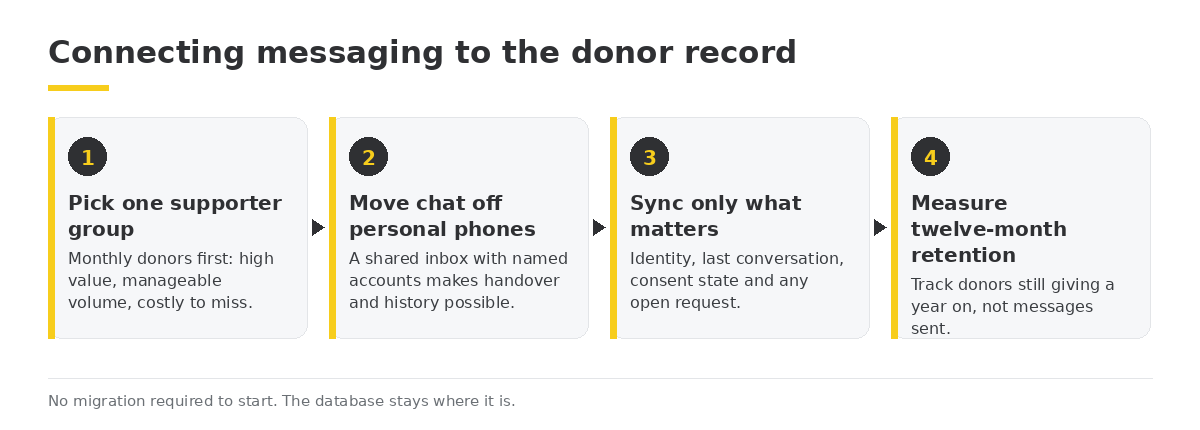
Move the conversation off personal phones. A shared inbox with named staff accounts is the single change that produces the biggest immediate improvement, because it makes handover possible and makes the history survive a resignation.
Agree the small set of fields that must sync. Resist the urge to mirror everything. Supporter identity, last conversation date, consent state and any open request are usually enough to stop the two systems contradicting each other. See how integrated CRMs work in practice for the general pattern.
Fix consent capture at the point of contact. Every new supporter should arrive with a channel preference recorded. Retrofitting consent for an existing list is slow; capturing it correctly from today is not.
Write the response playbook before you announce the channel. Who answers, in which hours, and what happens to a message at 22:00 on a Sunday. Publishing a messaging number without that is how a small team ends up feeling worse served by the new system than the old one.
Measure retention, not message volume. The number that matters is how many monthly donors are still giving twelve months later, and how many lapsed supporters came back after a conversation. If you want a walkthrough of that setup for your organisation, talk to the imBee team.
A CRM records and organises. It does not generate affection for your cause, and there are four failures it will not touch.
It will not fix a weak case for support. If supporters cannot say in one sentence what their money changes, better segmentation only delivers a clearer version of an unconvincing ask.
It will not fix an organisation nobody has staffed to answer. Opening WhatsApp, Instagram and web chat multiplies inbound volume. Without an owner and agreed hours, response times get worse, not better.
It will not fix dirty data you keep feeding it. Migrating a list with duplicates, dead numbers and unrecorded consent produces the same list inside a more expensive system. The cleanup is manual, and it happens before migration or not at all.
It will not create trust you have not earned. Donors in Hong Kong and Singapore increasingly ask how their data is handled and how much of their gift reaches the programme. Those are governance answers, not database answers.
| Symptom | Likely cause | Where the fix sits |
|---|---|---|
| Lapsed donors do not respond to reactivation | Nobody spoke to them between gifts | Stewardship calendar, not software |
| Duplicate supporter records keep appearing | Matching on email only | Deduplication rules and intake forms |
| Consent state disputed | Consent captured verbally, never recorded | Capture at point of contact |
| Messaging inbox overwhelms the team | Channel opened with no staffing plan | Hours, ownership and automated first replies |
| Campaign attribution unclear | Appeals not coded at send time | Campaign structure in the CRM |
Read against that list, the case for a nonprofit CRM gets sharper rather than weaker. It is the right tool for fragmented records, invisible conversations and unprovable consent. It is the wrong tool for a fundraising strategy that is not working, and no amount of configuration will make it the right one.
What is a nonprofit CRM?
A nonprofit CRM is the system of record for everyone connected to a charity — donors, volunteers, event attendees, corporate partners and grant contacts. It holds the constituent record, the giving and activity history, the campaign each gift came from, and the consent state for every channel, so that fundraising and programme teams work from the same view of a supporter.
How is a nonprofit CRM different from a fundraising database?
A fundraising database answers who gave what, when, and whether it was receipted. A nonprofit CRM covers the whole relationship, including people who volunteer or attend events without giving money. The practical difference shows up when a supporter appears twice — once as a donor and once as a volunteer — and nobody can see it is the same person.
Do small NGOs in Hong Kong need a CRM, or is a spreadsheet enough?
A spreadsheet works up to a few hundred supporters handled by one or two people. It stops working when conversations live on staff phones, when a colleague leaves, or when you cannot evidence what a supporter consented to. Those three pressures, rather than headcount or budget, are the usual signal that it is time to move.
Does privacy law apply to charities in Hong Kong and Singapore?
Yes. Charitable status is not an exemption. Hong Kong's Personal Data (Privacy) Ordinance (Cap. 486) applies to NGOs as it does to businesses, and its direct marketing provisions cover fundraising appeals. In Singapore, the Personal Data Protection Act and the Do Not Call provisions apply alongside the Charities Act framework overseen by the Commissioner of Charities.
Can we message donors on WhatsApp using our CRM data?
You can, provided the supporter consented to be contacted on that channel and you are sending through the WhatsApp Business Platform with approved templates. A receipt or a reply to a question the donor asked is transactional. A fresh appeal is promotional, and it needs consent you can evidence with a timestamp and a route.
How do we stop duplicate donor records from appearing?
Match on the identifiers you actually hold rather than email alone — in Hong Kong that usually means the mobile number plus English and Chinese name variants. Set the deduplication rules before migration, control how new records are created by intake forms and event sign-ups, and schedule a merge review rather than waiting for the annual appeal to expose the problem.
What should we look for in a nonprofit CRM for the APAC region?
Proper recurring-gift handling, consent stored as a history rather than a flag, deduplication on mobile numbers, receipting that satisfies your auditor, Traditional Chinese and English in the same record, and messaging channels that can write back to the supporter record. Ask to see a data export demonstrated before you sign anything.
How long should an NGO keep supporter data?
There is no single statutory answer. What both Hong Kong and Singapore expect is a retention period that is defined, documented and applied consistently, rather than records accumulating indefinitely. Set it against your own reporting and audit requirements, then have the system enforce it automatically so that deletion does not depend on someone remembering.

Kelly S.
Content Team Lead, imBee
Kelly S. owns content strategy, product positioning, and customer education at imBee. Previously, Kelly led B2B SaaS content programs and supported go-to-market initiatives for customer engagement products. On the imBee blog, Kelly covers conversational commerce, omnichannel messaging, WhatsApp Business, customer experience, and strategies for scaling business communications.
Questions about anything in this article? Talk to our team.